SECURITY CONFIDENTIAL
Security Confidential S2 E7 Nick Potts
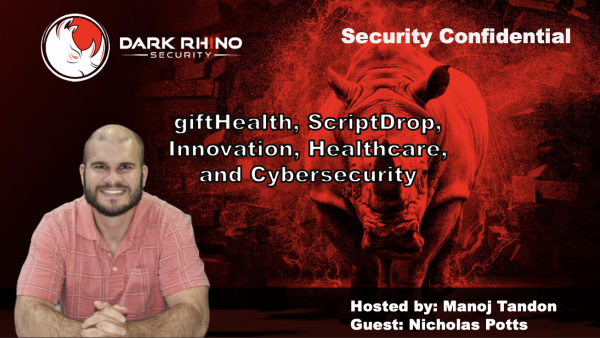
This week on Dark Rhiino Security’s Security Confidential podcast, Host Manoj Tandon welcomes Nick Potts. Nick Potts is a self made success story. He is the former CEO and founder of ScriptDrop and the current CEO of giftHEALTH. Nick shares his entrepreneurial journey. He discusses his past and current projects and the uniqueness behind them. Nick took ScriptDrop from zero to a highly […]
Video
This week on Dark Rhiino Security’s Security Confidential podcast, Host Manoj Tandon welcomes Nick Potts. Nick Potts is a self made success story. He is the former CEO and founder of ScriptDrop and the current CEO of giftHEALTH. Nick shares his entrepreneurial journey. He discusses his past and current projects and the uniqueness behind them. Nick took ScriptDrop from zero to a highly successful self sustaining growth company. Nick discusses his latest project, giftHEALTH, and the potential behind it. He provides insights into the innovation he sees coming in healthcare with AI. Nick also shares some thoughts on cybersecurity in healthcare in this interview.
Nick Potts on giftHealth, ScriptDrop, Innovation, Healthcare, and Cybersecurity
Chapter Titles:
00:00 Nick Potts’ Entrepreneurial Journey
02:22 Overcoming Fear and Building Startup Confidence
05:47 The Inspiration Behind ScriptDrop
13:20 The Vision and Innovation of Gift Health
16:25 Patient Experience and Healthcare Service Challenges
23:09 Cybersecurity Risks in Healthcare Systems
33:18 AI, Big Data, and the Future of Healthcare
Audio:
Spotify Embed: S2 E7 AI in Healthcare
Important Links:
Transcript
Manoj Tandon: Welcome, everybody, to another episode of Security Confidential. Today we are honored to have Nicholas Potts join us. Nicholas is an extremely successful entrepreneur who started his journey, you won’t believe it, at Enterprise Rent-A-Car and then from there ended up in Fortune Magazine as the CEO of ScriptDrop, a highly successful pharmaceutical delivery service. And now he has a new project in Gift Health. So, Nick, thank you for joining us. It’s a pleasure to have you on the program today.
Nick Potts: Yes, thanks for having me. I really appreciate the time and look forward to the conversation.
Manoj Tandon: By the way, did I miss anything there? I mean, you’re a very successful person. I want to give you all due credit here, so is there any part of your bio that I skipped over by chance?
Nick Potts: No, I definitely had a great experience working at Enterprise Rent-A-Car directly out of college. And then I joined CoverMyMeds for a number of years and got to help grow that software company, which was eventually acquired by McKesson for a little over a billion dollars. And then I left CoverMyMeds to start ScriptDrop about four and a half or five years ago. Over the time that I was the CEO of ScriptDrop, we got up to about 150 full-time team members, and this solution is used by thousands of pharmacies across the country and has helped, I believe, up to three or four million patients at this point, which, of course, is what we’re in healthcare for—to help those patients. So that’s all really exciting.
Manoj Tandon: That’s incredible. What a great story. We’ve had so many CEOs and entrepreneurs on past episodes, and all of their journeys were very unique. Part of our mission here is, of course, to talk about cybersecurity, but also to broaden people’s horizons a little bit, and that’s why those journeys become so relevant in case there’s someone else listening that wants to consider pursuing their own dreams. From Enterprise to Gift Health to ScriptDrop, how did you make that transition?
Nick Potts: If you’ve never done something, that does not mean you can’t do it or you can’t learn to do it. Just having that confidence in, “Hey, I can figure this out. I have the ability to if I work hard enough, and I can find success in that.” Whereas a lot of folks end up not becoming an entrepreneur or launching a company, and it’s often due to fear. Once you can get past that, you can really see what type of ceiling you have, and it’s incredibly exciting to do so.
Manoj Tandon: On a past episode, one of the pieces of advice was never make decisions out of fear. If you’re going to do something, do it with self-confidence and commitment. I think that’s easy to say, but in my own instance that was a very difficult thing to get over. It’s not a trivial bump.
Nick Potts: Humans are social creatures, so even if you say your neighbors or friends’ opinions don’t matter, they do. That is oftentimes what leads to fear. It’s, “Hey, I could start this company, but I look at the stats and it says 90% or 95% of startups fail.” So that’s a high likelihood that my friends may make fun of me or my neighbors may laugh at me. But even if you do fail—and I’m using air quotes when I say “fail”—you actually succeed in that journey by launching something and building a company. Even if the company ends up not working out after four years, you still become much stronger because of the experience. You’re better prepared for the next thing that happens in your career, whether that’s joining another company or starting another startup.
Manoj Tandon: Nick, let me ask you: Did you have a background in pharmaceuticals out of college? Was that what your education was?
Nick Potts: Yeah, not at all. I grew up in Nashville, Tennessee, so I grew up in Music City. I can’t sing or play instruments, so that wasn’t working in that city. Growing up, I wasn’t really into technology. I don’t even think I had a computer at my house until I was in college. But I really got into technology once I moved from Nashville to Columbus and then got into the pharmacy space when I joined CoverMyMeds. I was fortunate to work under some incredibly experienced people, and they expedited my learning. What may have taken me 10 years to learn, I was able to condense into about two and a half or three years at CoverMyMeds, and it really set me up to succeed or at least have a better chance of success with ScriptDrop and now Gift Health.
Manoj Tandon: Was there someone that helped you come up with the big idea for ScriptDrop, or was that your own brainchild? How did that innovation happen?
Nick Potts: That was my own brainchild. I’m really big into data, so I would pull reports just for fun, which sounds crazy to some people. I like looking at the data and understanding the numbers, conversions, and tracking patients or users through platforms. I noticed that patients across the country, if they were asked to come back to the pharmacy because their prescription wasn’t ready immediately, about 15 to 22 percent of patients would never return to pick it up. That creates huge problems if someone has heart disease or another serious condition and never gets the medication they need. The simple premise for ScriptDrop was to build software that integrates within the pharmacy’s workflow and systems to allow pharmacies to offer prescription delivery instead of asking patients to come back a second or third time.
Manoj Tandon: So by inference, what you just stated is there are 15 to 22 percent of patients who are non-compliant with the doctor’s orders.
Nick Potts: That’s actually just the side that don’t go pick up the prescription. There are studies showing that even patients who do pick up their prescriptions—up to 50 percent of them—are non-compliant or non-adherent. They don’t take the prescription the way the doctor told them to. They forget doses, cut pills, or stop taking them early. It’s a huge problem in the healthcare system across the country.
Manoj Tandon: You had a report on LinkedIn several months back that listed all the conditions people take medications for, from anxiety to diabetes. I was amazed at the amount of people taking anxiety medications alone. To think that maybe 50 percent of them are non-compliant means they’re really not even getting better. What you described with ScriptDrop at least takes one piece of inertia out of the way. If they’re getting their drugs, maybe they’ll be more apt to take them.
Nick Potts: The term I often use is patient friction. The more friction you have in the system—whether it’s making appointments, getting surgery, or picking up prescriptions—the more patients you lose at each step. The more friction we can remove with technology, the better outcomes patients will have.
Manoj Tandon: I’m curious, what happens to these medications that aren’t picked up? Once the pharmacist fills them, do they get recycled?
Nick Potts: If the pharmacist fills the prescription and you don’t pick it up, legally they have 14 days to either ship it to you, deliver it, or have you come in. After that they run what’s called a reversal, sending the transaction back to the PBM that manages payments. Then the pharmacy can either return the medication to the wholesaler or keep it in inventory for the next patient. So the medication itself isn’t necessarily wasted, but the opportunity to impact that patient’s health is lost.
Manoj Tandon: What about controlled substances and the drivers delivering them? Do they need certifications?
Nick Potts: It depends on the state. Some states have different regulations around controlled substances. But what we found is that creating a consistent package for every delivery removes complexity because the driver never knows what type of prescription they’re delivering. It’s just a generic package or envelope, which cuts down on fraud and abuse potential.
Manoj Tandon: Going back to friction, healthcare is so driven by third-party payers. How was your service paid for? Insurance companies, patients, or pharmacies?
Nick Potts: It varies. Some PBMs have started paying for prescription delivery on behalf of pharmacies and patients, but frequently the cost falls on either the pharmacy or the patient. Some pharmacies offer slower delivery for free and allow patients to upgrade for expedited delivery. Others ensure delivery is always free. It really varies depending on geography and the pharmacy model.
Manoj Tandon: I figured that payment process itself would create friction.
Nick Potts: Absolutely. If a patient can barely afford a copay, adding delivery costs may make treatment financially impossible. That’s really sad.
Manoj Tandon: What’s the model at Gift Health? What are you doing there?
Nick Potts: We have a huge vision for Gift Health. We acquired an operational pharmacy that we’ll use like a software test kitchen. We can test software there before pushing it out to thousands of pharmacies nationwide. The core platform will become a smart prescription routing platform where any physician or patient in the country can send prescriptions to Gift Health, and we’ll route them to the best pharmacy based on price, proximity, inventory, delivery, or whatever matters most to the patient.
Manoj Tandon: That’s a very cool idea.
Nick Potts: We’re very excited about it. Other companies have attempted something similar, but our differentiator is our background in pharmacy technology integrations and our nationwide pharmacy network to create a fantastic patient experience.
Manoj Tandon: Let’s talk about patient experience. In cybersecurity and managed services, SLAs are everywhere. We commit in writing to service standards. I haven’t really seen anything like that in medicine for patients. Why is that?
Nick Potts: There are service levels baked into reimbursements and enterprise contracts, but patients often don’t see or understand them. In healthcare, the patient isn’t always viewed as the direct customer because the physician or hospital is often paid by insurers or PBMs. That affects communication and service. But there are still many physicians, pharmacists, and healthcare workers who provide exceptional service and care deeply about patients.
Manoj Tandon: How is Gift Health progressing? Are you seeing traction?
Nick Potts: It’s going really well. We started working on it just a couple of months ago and raised capital from investors including Mucker Capital and Alos Ventures. We’ve already closed on the pharmacy acquisition and are actively building the software. We’ll launch the public version for patients, physicians, and pharmacies in February.
Manoj Tandon: You managed to raise capital while being based in Columbus instead of Silicon Valley or Boston. How did you break that mold?
Nick Potts: Columbus has had companies like CoverMyMeds, Root Insurance, and Olive create huge success stories that helped pave the way. Raising capital is also easier as a second-time founder. At ScriptDrop, I got turned down by over 70 investors and spent nine months raising our seed round even after having signed customers. It was definitely rough. But now with Gift Health, it’s easier in some ways because investors understand the scale of the vision.
Manoj Tandon: About 20 percent of Dark Rhino Security’s clients are healthcare-related. One thing we’ve noticed is that despite healthcare spending huge amounts on technology, the spend on cybersecurity is tiny relative to the risk. We’ve seen hospitals and healthcare systems lose sensitive patient data. What are your thoughts on cybersecurity in healthcare?
Nick Potts: I think many healthcare organizations assume their EHR or EMR vendor handles security for them. But as companies grow and technology becomes more complex, they need cybersecurity strategies outside their core vendors. You can get socially engineered or hacked in many different ways. It’s important to have cybersecurity resources and employee training because technology will become more ingrained in every workflow, especially as AI becomes more prevalent.
Manoj Tandon: Healthcare is such a vulnerable target because attackers are motivated by money.
Nick Potts: Exactly. If you’re a hospital administrator, you’re focused on hundreds of different responsibilities. But if someone is trying to hack your system, that’s their full-time focus. They’re going to be better at attacking your systems than you are at defending them if you’re distracted by 200 other priorities. That’s why having dedicated cybersecurity partners or teams is critical.
Manoj Tandon: I’m going to steal those words from you because you summed it up perfectly.
Nick Potts: We got to the point at ScriptDrop where we had an entire team focused solely on security and making sure the system was as impenetrable as possible. But many companies don’t have those resources, so it becomes about finding the right partner.
Manoj Tandon: Looking ahead 15 years, where do you see healthcare technology going?
Nick Potts: I’m excited about companies applying AI to drug discovery. I think AI will help discover breakthrough drugs and maybe even solve diseases like cancer. But one of the biggest barriers is access to data. Healthcare has so many silos that companies can’t build full datasets to apply AI effectively. Once data standards improve and healthcare data becomes more collaborative, innovation will accelerate dramatically.
Manoj Tandon: Do you see big data lowering healthcare costs?
Nick Potts: Yes, but there are entrenched incumbents and barriers. At Gift Health, we want to impact prescription costs by building out a PBM-as-a-service platform. Think of how Twilio simplified launching SMS applications. We want to do the same for PBMs so entrepreneurs and enterprises can launch their own PBM platforms without understanding all the technical plumbing. More competition in the PBM space should drive down drug prices for everyone.
Manoj Tandon: Is that where the name Gift Health comes from?
Nick Potts: Good health is a gift, and people don’t truly value it until they experience illness. The company name is a constant reminder that we want to help give that gift to patients through better health outcomes.
Manoj Tandon: That’s a noble mission, and it’s great to hear someone speak about healthcare with genuine heart behind it.
Nick Potts: There are so many opportunities to create positive impact in healthcare. These are difficult problems, but that’s what makes them exciting.
Manoj Tandon: Nick, we really appreciate your time today. Is there anything you’d like to plug before we wrap up?
Nick Potts: Not right now. COVID has made events tougher, but I did recently join the Columbus Leadership Council. I’m excited about the opportunity to get involved in the community, mentor others, and continue learning and growing myself.
Manoj Tandon: Fantastic. On that note, Nick, we really appreciate your time. Thank you for joining us today.
Nick Potts: Absolutely. Thanks so much for having me. I really appreciate it.
To learn more about Nick Potts visit his LinkedIn
Check out the other episodes in Season 2:
Ep. 0 Luis Martin – The Origins of Artificial Intelligence
Ep. 1 Ida Abdalkhani – Grow your career, quit your job, and laughter yoga
Ep. 2 Phil Rich and Kevin Swift – Do you have the Chutzpah to be an entrepreneur?
Ep. 3 Jordan Graham – SOC2 Compliance, can it be done on the cheap?
Ep. 4 Matt Castonguay – Gamer to Millionaire
Ep. 5 Jay Sheehan and Jordie Kern – How to Hire Heros
Ep. 6 Ethan Nicholas – Successfully Network and Achieve Success
Ep. 8 Warner Moore – Risks in Cybersecurity
Ep. 9 Chris Gerritz – Prevention Paradox
Ep. 10 Karen Hough – New Year New Beginning Leverage Improv
About Nick Potts
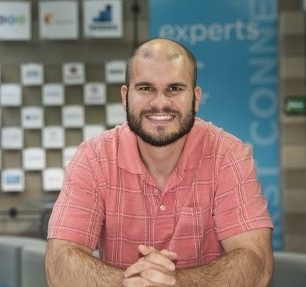
Nick Potts is a self made success story.
He is the former CEO and founder of ScriptDrop and the current CEO of giftHEALTH.
Nick shares his entrepreneurial journey.
He discusses his past and current projects and the uniqueness behind them.
Nick took ScriptDrop from zero to a highly successful self sustaining growth company.
Nick discusses his latest project, giftHEALTH, and the potential behind it. He provides insights into the innovation he sees coming in healthcare with AI.
Nick also shares some thoughts on cybersecurity in healthcare in this interview.
About Us:
Dark Rhiino Security’s Security Confidential is a weekly Cybersecurity podcast where Host, Manoj Tandon, talks to Infosec and Cybersecurity professionals about the current issues going on in our industry. Guests are able to share their stories about how they began their journey into cybersecurity and connect with our audience. Listeners are able to tune in through Spotify, Apple Podcasts, Google Podcasts, Amazon Music, iHeartRadio, Youtube, LinkedIn, and more.
For inquiries, please email media@darkrhiinosecurity.com
Share and spread the word!
Original podcast listings
Archive source: Original website record. Original wording and artwork retained.