
SECURITY CONFIDENTIAL
Security Confidential S2 E10 Karen Hough
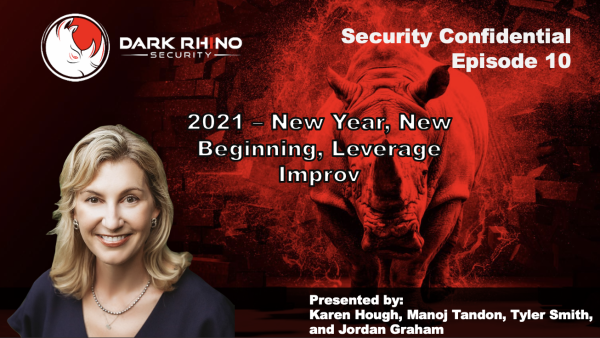
This week on Dark Rhiino Security’s Security Confidential podcast, Host Manoj Tandon welcomes Karen Hough. Karen is the founder and CEO of ImprovEdge. This past year has presented companies and people with severe never before navigated challenges. For many, 2020 could not end soon enough. 2021 is a new beginning. Improvisation and resilience are themes from last […]
Video
This week on Dark Rhiino Security’s Security Confidential podcast, Host Manoj Tandon welcomes Karen Hough. Karen is the founder and CEO of ImprovEdge. This past year has presented companies and people with severe never before navigated challenges. For many, 2020 could not end soon enough. 2021 is a new beginning. Improvisation and resilience are themes from last year that carry into this year and will be with us well into the future. Cybersecurity is about helping companies become more resilient. Becoming resilient requires us to become more comfortable with improvisation. Karen helps us navigate this. The discussion focuses on improv, overcoming preconceived notions, and being resilient. There is advice and exercises that would benefit all.
Karen is a #1 Amazon bestselling author, recipient of the Silver Stevie Award for Most Innovative Business of the Year, and won both the WNBA Inspiring Woman Award and the WBENC PitchPivot Grand Prize. She is a philanthropist, Yale grad, avid hiker and lives in Ohio with her husband and 3 children. Her books include: “The Improvisation Edge: Secrets to Building Trust and Radical Collaboration at Work”, “Be the Best Bad Presenter Ever: Break the Rules, Make Mistakes and Win Them Over”, and “Go With It: Embrace the Unexpected to Drive Change”. We are also joined by Tyler Smith and Jordan Graham in the discussion.
Security Confidential: New Year New Beginning Leverage Improv
Chapter Titles:
00:11 Welcoming Karen Hough Back to Security Confidential
04:11 How Improv Builds Trust, Adaptability, and Teamwork
09:52 Leadership, Resilience, and Navigating Uncertainty
16:36 The Future of Remote Work and Company Culture
20:02 Mental Health, Burnout, and Virtual Exhaustion
35:47 The Two-Headed Expert Improv Exercise
45:20 Workplace Dynamics, Gender Challenges, and the Future of Work
Audio:
Spotify Embed: S2 E10 New Year, New Beginnings
Important Links:
Transcript
Manoj Tandon: Welcome, everybody. Welcome to the show, another episode of Dark Rhino’s Security Confidential. Today we are honored to have Karen Hough back. She joined us eight or nine episodes ago, and she is gracing us with her presence again. For those of you that may not recall, Karen is quite special. She is the founder and CEO of Improv Edge. Improv Edge creates business training with an improv twist. This is not going to be about improvisation, so it should be interesting. But she is in the top 1% of women-owned businesses in the U.S., and she is an Amazon number one best-selling author, recipient of the Silver Stevie Award for Most Innovative Business of the Year, and won both the WNBA Inspiring Women Award and the WBENC Pitch Pivot Grand Prize. She is a philanthropist, Yale grad, avid hiker, and lives in Ohio with her husband and three children. Her books include The Improvisation Edge: Secrets to Building Trust and Radical Collaboration at Work, Be the Best Presenter Ever: Break the Rules, Make Mistakes, and Win Them Over, and Go With It: Embrace the Unexpected to Drive Change. She is also the creator of the Yes Deck, a deck of cards packed with business tips. Thank you for joining us, Karen.
Karen Hough: Oh, it’s such a pleasure to be here, Manoj. Thank you for having me again.
Manoj Tandon: Yeah, and this time we have some company. I know we’ve been chatting. We have my partner Tyler Smith joining us and our newly promoted Manager of Operations, Jordan Graham, on the line. They seem to be nothing but trouble if our initial chatting is any indication.
Karen Hough: They are nothing. Yeah. Yeah, we’ll be okay. We’re not bad. We’re fine. I don’t know about that.
Manoj Tandon: They’re both ex-military veterans, so thanks for your service, guys.
Karen Hough: Thank you for your service. Thank you so much.
Manoj Tandon: I think that’s had a bad influence on them because improvisation is something, Tyler, you did for a living actually. We won’t talk much about the field work, but I think Karen’s all about improv, and man, your line of work way back when was a lot of improvisation, I would imagine.
Tyler Smith: It was. It was.
Manoj Tandon: So Karen, you know last time when we got together, we talked about resiliency and improvisation and how to leverage those things to make a better company culture, be happier, have better health, all these wonderful things. One of the things I’d love to do—last time I was the only person that was experimented on—I would like to try some of these techniques here with these guys too, because I can tell you I think I’d love to do the “Yes And” experiment with them. Do a little improv role if you don’t mind. Before we even go there, I guess let’s talk about the “Yes Space” and whatnot. Give us a little intro here.
Karen Hough: Sure. By the way, we can also play a different game. Okay, we already did right. You know, when you tell Marines that you have games to play, we know what that means. Are we going on a 20-mile ruck for no reason? Yes, okay. Yeah, we can play games too. Remember that. Let’s give you a little advance notice. I absolutely know that the two gentlemen who join us must understand improvisation, because from an artistic standpoint, improv is the art form where about five or six actors come on stage and we have no script, we have no props, we have no costumes. I was lucky enough to be trained and I performed with The Second City in Chicago, and I went on to start my own improv troupes. I had a fabulous acting career; it was my first of many careers—at least three—and it allowed me to understand that as long as you have your team, as long as you have what we call your ensemble or your troupe, you’re going to be fine because you don’t know what’s going to happen next. You have no idea how the audience will react, and you have a general guideline for how to do this really well. Then you trust the people on stage with you to catch you if you fall, to make it better. You don’t even have to have the whole answer; you’ve just got to bring one block. That’s sort of the “Yes And.” We call it “Yes Space” and building blocks. The foundational principle of improv is “Yes And.” In other words, if one of you gives me something on stage, like you say, “Hey, Karen, we’re astronauts,” my job is to say, first of all, “Yes, we’re astronauts, and…” I think the reason that that’s so meaningful for the corporations we work with—and we also, by the way, work with a lot of government entities like the Department of Commerce and the U.S. Army and the Department of Defense—is that improv, in its essence, can change professional behavior for the better. So although we’re business training with an improv twist, we not only use improv, but we marry it with psychology and neuroscience. We’ve been doing this work for 20 years with all sorts of organizations. By marrying those ideas behind why this matters, people can then go, “Oh, I see,” and apply it to their work.
Tyler Smith: Yeah. You would have an operation order, a sand table, everything, and you know how it’s supposed to go. And then reality hits. The Marine Corps would call that “adapting and overcoming,” right? It’s really the same principle.
Manoj Tandon: It’s interesting in what you say, Karen, because I also think back. Much like you, in my early days of college, my early studies were in jazz. That’s exactly it. Jazz improv is the same thing. I think back to your “Yes And” description of the process. I think back to when I first went to college, one of the things they had us do in the first week of school for jazz improv was learning to feed off of another musician. They wanted us to learn: “Okay, I hear that. I’m going to incorporate that and add some embellishment on top of that.” It’s really interesting you say that. A lot of things come to mind. Jazz is just riffing on your mistakes.
Karen Hough: Yes. In addition, as I think about the sand table analogy, the scariest thing I ever had to do was walk out in front of a drunk audience. Again, my admiration and gratitude for what you guys did. But I will tell you, the minute that this pandemic started and everything started to go crazy, the depth and richness of the conversations I was having with business leaders all over the world hadn’t been that meaningful probably since the 2008-2009 recession. Suddenly this analogy of having to figure it out when utterly the last thing you ever thought would happen happens, and you have to be positive and flexible in the face of all of this, was so meaningful to them.
Jordan Graham: Just listening to you speak about the specific and more granular details of what you do, when you start talking to me about improv, my mind instantly shifts to leadership because this is heavy on decision-makers. In order to improv, you have to have quality leadership in place. If you don’t have quality leaders, the decisions that come from the improvised approach could be detrimental. How do you approach that? Are you trying to get everybody in the organization to improv? Are you focused on just the key stakeholders and leaders of an organization to make those decisions, or is it a hybrid solution of everybody top to bottom?
Karen Hough: Yes, and from a cultural standpoint, we work with a lot of organizations to look at their culture, and we marry improv with the mission and vision they already have in place. Jordan, you asked a lot of questions in that one. Yes, we work throughout the organization, and I would say probably some of our more successful work is when we begin with the leadership. The fourth principle that we trademarked with Wharton is the obstacle. The idea is, number one: mistakes happen. In the artistic world, they happen all the time. The key is not to shove them under the rug or try to act like it didn’t happen. We call it “Acknowledge It, Deal With It, Move On.” The idea is that if leaders are courageous and flexible and vulnerable enough to say, “Wow, that was the wrong decision,” or, “That’s not the way that we thought it would happen,” acknowledging it is the number one courageous thing. Then they have to deal with it and move on.
Jordan Graham: That’s a skill in and of itself that I’ve learned in my young professional career. Strong leadership has to have the ability to first admit that you were wrong. Secondly, you have to have the ability to go back and fix it.
Karen Hough: Mistakes are opportunities; it just depends on how you choose to respond. This entire situation globally is so difficult, and yet we continue to see silver linings of opportunities to thrive, make a new product, be kind, be philanthropic, and be a greater member of the community.
Manoj Tandon: We think that remote is going to be the way forward. We’ve learned that you don’t really have to be in the office to be in the office, if you will. Is there going to be a place for brick and mortar? Sure, there is. There are some functions in our company that absolutely require people to be on site because we can’t let people access client data from their home networks. But by and large, I think there’s a shift in culture that’s going to take place, and I think there is a change in efficiency that goes along with that. There is a change in respect for the team members because you have to trust that they are doing the right things at the right time.
Karen Hough: My concern for the mental state of people across the world is probably at the highest it’s been in a very long time. When I have the same conversations with people on three continents around their stress, the leakage of work into their lives, the overwhelm, the lack of self-care, it is incredibly concerning. The organizations that saw it early are saying, “Okay, time out. We’ve got to fix this.” Leaders now have to manage individuals. The leaders that are really struggling are the ones expecting people to work exactly the same way they did in the office, or they have not spent enough time understanding each individual need of the people.
Tyler Smith: Both Jordan and I have little ones. I have a six-year-old; Jordan has a two-year-old. You’re absolutely right because in our case, my son’s school was canceled, and usually he’s screaming while this podcast is going on because he wants something.
Karen Hough: Human connection has never been more important. The gold standard is being in a room with another person. When our trainers can someday be in the room with people again, there’s nothing that replaces it. The next standard is virtual, being able to see each other, but making sure that we’re not demanding that people do that all the time because it’s mentally exhausting. Employees want more one-on-one time with their managers. They’re feeling lonely. They also want more get-togethers virtually with their teams because they miss each other. Those critical social connections, which make us more resilient and healthy and help us understand and trust our team members, are disintegrating. We have to work at it.
Manoj Tandon: We have this standing call that we do three days a week. The original intent was exactly what you’re saying: just chat and get together. The team needs to know about the team, and the team needs to know that they are still a team even though they are remote.
Karen Hough: Virtual exhaustion is getting worse. We have got to start setting boundaries because people I talk to—it’s noon, they haven’t eaten, they’ve been up since six, they went straight to work, they haven’t combed their hair. Physically and mentally, there is no way we can sustain this. Leadership needs to drive healthy boundaries. We use “25/55.” If you set a 30-minute meeting, end it at 25 minutes so people can get up, use the restroom, or grab coffee. If it’s a 60-minute meeting, end it at 55 minutes. Otherwise people are sitting for seven hours straight, and it’s incredibly fatiguing. Not everything needs to be a meeting. If you’re just sharing information, that’s an email. Sometimes you should just call someone and take a walk around the block while talking instead of staring at another screen.
Karen Hough: I think we should play an improv game. I need a volunteer to play the game with me. Tyler? What we’re going to do is answer all the questions that are burning in your minds. This is a classic improv game called “The Two-Headed Expert.” We are experts, and we are going to answer any questions that these two can throw at us. The way we answer these questions is one word at a time. I’ll say the first word, Tyler says the second, I say the third, and so on. The answer doesn’t have to be technically correct because we’re the experts.
Jordan Graham: What is the impact that improv can have on a business’s effectiveness?
Karen Hough and Tyler Smith: “Improv has the most impact when you implement it with a big jar of gummy bears so you can distribute it to everyone.”
Manoj Tandon: Why was there nobody in the SOC yesterday, Tyler?
Karen Hough and Tyler Smith: “There was no one in the SOC yesterday because Kevin didn’t think about bringing a sledgehammer to open the door.”
Karen Hough: So Tyler, tell me what it was like to play that game with me.
Tyler Smith: Very quickly, I had to visualize where it might be going and then just grab a possibility out of the air and go with it.
Karen Hough: That’s the point. People have words they want the other person to say next, and when they don’t get the word they expect, it throws them off. They cannot stand giving up control to play the game. It’s about collaborating with vulnerability, lack of control, and listening. Research shows that most adults stop listening about halfway through every sentence because we are so busy thinking about our answer instead of being in the moment and listening. Improv taught me that we rarely as adults are truly in the moment.
Manoj Tandon: Have you seen a change in the way men and women in business settings interact?
Karen Hough: I would say yes, and it’s both better and worse. Remotely, in some ways, people are actually somewhat safer physically and mentally because it’s harder for innuendos and things like that to happen. But on the other side, we’re watching a ridiculously higher percentage of women leaving the workforce. Many of the gains we’ve had over the last few decades are utterly being lost because women are faced with impossible decisions around family, illness, and business. They don’t have daycare, they can’t bring elderly parents home to help, and something has to give. Usually it’s the woman’s career. We’re losing exponentially more women from the workforce right now in order to care for everything happening.
Manoj Tandon: Karen, we want you back. It’s always a very interesting conversation with you. Karen, Jordan, Tyler, I really appreciate all you guys taking the time to join us today. It was wonderful to have you, and thanks for all the great advice. Happy holidays and a Happy New Year.
Learn more about Karen on her LinkedIn
Check out the other episodes in Season 2:
Ep. 0 Luis Martin – The Origins of Artificial Intelligence
Ep. 1 Ida Abdalkhani – Grow your career, quit your job, and laughter yoga
Ep. 2 Phil Rich and Kevin Swift – Do you have the Chutzpah to be an entrepreneur?
Ep. 3 Jordan Graham – SOC2 Compliance, can it be done on the cheap?
Ep. 4 Matt Castonguay – Gamer to Millionaire
Ep. 5 Jay Sheehan and Jordie Kern – How to Hire Heros
Ep. 6 Ethan Nicholas – Successfully Network and Achieve Success
Ep. 8 Warner Moore – Risks in Cybersecurity
Ep. 9 Chris Gerritz – Prevention Paradox
Ep. 10 Karen Hough – New Year New Beginning Leverage Improv
About Karen Hough

Karen Hough is the Founder & CEO of ImprovEdge, which creates business training with an improv twist, and is in the Top 1% of woman-owned businesses in the US.
She is a #1 Amazon bestselling author, recipient of the Silver Stevie Award for Most Innovative Business of the Year, and won both the WNBA Inspiring Woman Award and the WBENC PitchPivot Grand Prize. She is a philanthropist, Yale grad, avid hiker and lives in Ohio with her husband and 3 children.
Her books include: “The Improvisation Edge: Secrets to Building Trust and Radical Collaboration at Work”, “Be the Best Bad Presenter Ever: Break the Rules, Make Mistakes and Win Them Over”, and “Go With It: Embrace the Unexpected to Drive Change”.
She is also the creator of the “Yes! Deck”, a deck of cards packed with business tips.
About Us:
Dark Rhiino Security’s Security Confidential is a weekly Cybersecurity podcast where Host, Manoj Tandon, talks to Infosec and Cybersecurity professionals about the current issues going on in our industry. Guests are able to share their stories about how they began their journey into cybersecurity and connect with our audience. Listeners are able to tune in through Spotify, Apple Podcasts, Google Podcasts, Amazon Music, iHeartRadio, Youtube, LinkedIn, and more.
For inquiries, please email media@darkrhiinosecurity.com
Share and spread the word!
Original podcast listings
Archive source: Original website record. Original wording and artwork retained.