
SECURITY CONFIDENTIAL
Security Confidential S17 E8 Ed Gaudet
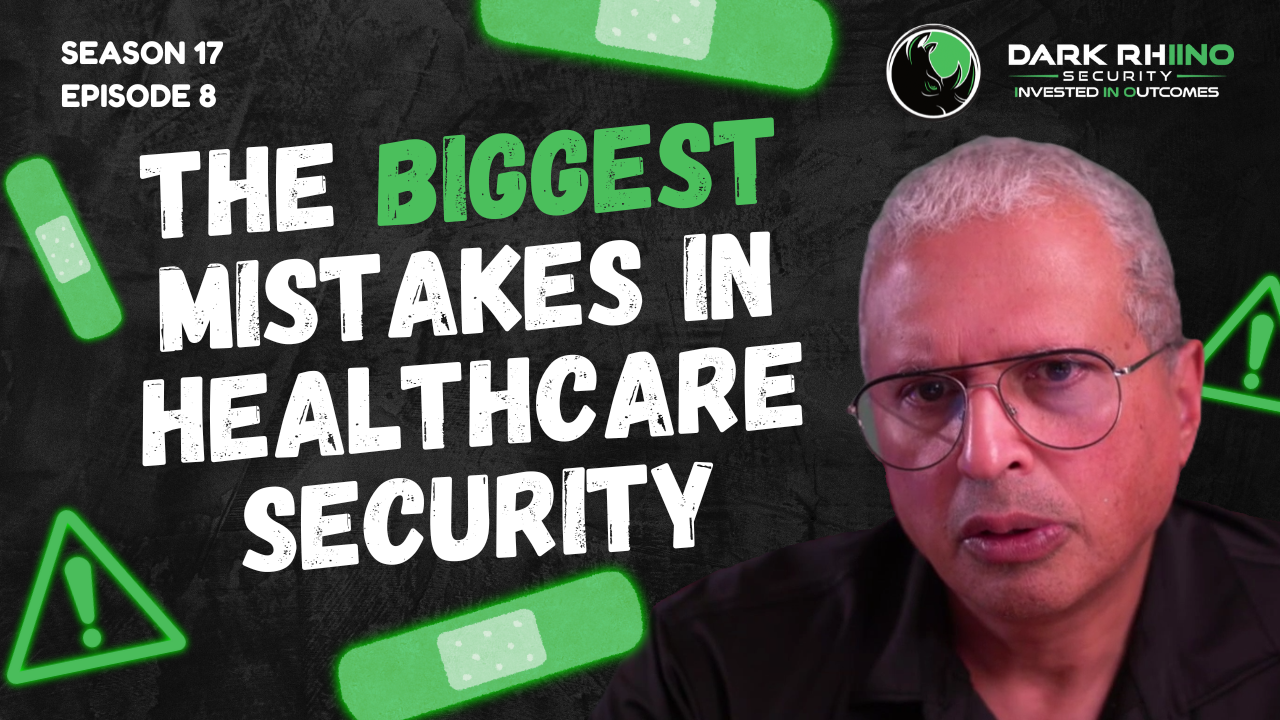
This week on Dark Rhiino Security’s Security Confidential podcast, Host Manoj Tandon talks to Ed Gaudet. Ed is a thought leader on enterprise risk, third-party risk management, and the future of cyber governance in the age of AI. He brings over 25 years of software leadership experience in cybersecurity, risk management, and healthcare IT. Known for driving […]
Video
This week on Dark Rhiino Security’s Security Confidential podcast, Host Manoj Tandon talks to Ed Gaudet. Ed is a thought leader on enterprise risk, third-party risk management, and the future of cyber governance in the age of AI. He brings over 25 years of software leadership experience in cybersecurity, risk management, and healthcare IT. Known for driving innovation at companies like Imprivata and Liquid Machines, Ed holds multiple patents in secure data sharing and authentication. Today, he’s the CEO and Founder of Censinet.
The Biggest Mistakes in Healthcare Security | Security Confidential
Chapter Titles:
00:00 Introduction
11:08 From a CEO: Is college necessary?
13:53 Why should an SMB care about Third-party risk?
16:49 Why don’t healthcare companies take this seriously?
20:58 Understanding the process from a business perspective
22:40 Leverage the Automation
31:41 Jobs are changing with AI
35:58 AI Risk
38:29 Censinet
46:10 Recurring themes that anyone can fix
49:57 More about Ed
Audio:
Spotify Embed: S17 E08 The Biggest Mistakes in Healthcare Security
Important Links
Transcript
Manoj Tandon:
Hello everyone, this is your host, Manoj Tandon, with another episode of Dark Rhiino Security’s Security Confidential. We’ve got another awesome guest today! But before we begin, please hit that Like and Subscribe button—because, as I always say, we all work for the algorithm. The more you do that, the more we can keep bringing you great content and incredible guests like the one joining us today. Without further ado, I’d like to introduce Mr. Ed Gaudet—CEO and founder of Censinet. We’ll talk about that shortly. Ed is a thought leader in enterprise and third-party risk management, and deeply involved in cyber governance in the age of AI. With over 25 years of software leadership experience spanning cybersecurity, risk management, and healthcare IT, Ed has driven innovation at companies like Imprivata and Liquid Machines.
Ed, thank you so much for being here and taking time out of your busy schedule.
Ed Gaudet:
Thanks, Manoj. It’s a pleasure to be here.
Manoj Tandon:
Our audience loves a good origin story. Did you always want to be a computer science guy growing up?
Ed Gaudet:
No—hell no! I was a hippie, a beatnik poet. I still write poetry, actually. I’ve been published in JAMA—that’s the Journal of the American Medical Association—and in several literary magazines. Writing was my first love. I’ve been doing it since I was a kid, maybe third or fourth grade.
Manoj Tandon:
Really? That’s amazing!
Ed Gaudet:
Yeah, and the older I get, the more time I devote to it. As I like to say, we don’t have that much time left on this planet—so hug who you love and what you love.
Manoj Tandon:
Amen to that. We were talking earlier about how the years ahead are far fewer than the ones behind us. So, how did a poet end up in governance and risk management?
Ed Gaudet:
That’s what I love about life—it takes you places you never expect if you stay open to the journey. I went to Bentley University, which is primarily a business and accounting school near Boston. I was a writer there of all things. Eventually, I was forced to join the military, which brought just the right amount of discipline to balance my inner hippie.
I graduated high school in ’83—yeah, I’m turning 60 this year! I’ve always loved the Grateful Dead; still go to shows when I can.
Manoj Tandon:
That’s awesome.
Ed Gaudet:
Yeah, back in the day my neighbor, who was our Dungeons & Dragons Dungeon Master, was also building computers. That got me into tech. I took a programming class in college, then joined a startup right out of school as a technical writer.
Manoj Tandon:
Was it Microsoft by any chance?
Ed Gaudet:
Ha! I wish. I should’ve bought Microsoft stock back then. No, it was a small company helping customers migrate off VAX/VMS systems from Digital Equipment. We built products like an editor called EDT, a DCL emulator, and early backup and email tools for Unix, DOS, and OS/2. That was my introduction to startup life.
Within a year, I was running marketing. Within two, I was running sales—traveling the world as a kid, feeling a bit of imposter syndrome. I learned everything on the job. I’m a self-taught learner, an autodidact.
Eventually, I realized I loved identifying market needs, building products that automate manual processes, and changing the way people work
Manoj Tandon:
At what point did you start your own ventures?
Ed Gaudet:
I’ve worked at about eleven companies in my career. Some I founded, others I joined early as a founding executive. Some were successful, others failed. But failure teaches more than success ever does. It defines who you are and how you recover.
Manoj Tandon:
That’s a great batting average though—you’re doing better than Warren Buffett!
Ed Gaudet:
Ha! I’ll take that. But yes, the failures are where you really learn.
Manoj Tandon:
We have a lot of young listeners. For someone thinking about leaving a stable job to start something new—what advice would you give?
Ed Gaudet:
Just do it. Whether you’re young or old, don’t let “time” become an artificial barrier. If you have an idea or a passion, go for it. Even if you fail, you’ll learn more about yourself than you ever imagined.
To me, the unknown is exciting—it’s what gets me out of bed every morning.
Manoj Tandon:
That’s the opposite of what most people feel—most fear the unknown.
Ed Gaudet:
True, but that’s the human survival instinct. People crave safety, but if you never take a risk, you’ll never grow.
Manoj Tandon:
So what about young people debating whether to go to college?
Ed Gaudet:
College, for me, was about more than learning—it was an experience. I wasn’t the best student my first year at Bentley, and my dad threatened to pull me out. So I joined the military, went through basic training, earned an ROTC scholarship, and finished school.
That experience taught me discipline and persistence. I met my wife there—we’ve been married 35 years, have three daughters, and just welcomed our first grandchild. None of that would’ve happened if I hadn’t gone to college.
My advice? Have a plan—but be open to how it changes. Life will take you places you never expect.
Manoj Tandon:
Let’s shift gears to third-party risk. Many SMBs think, We’re small—no one’s targeting us. Why should they care?
Ed Gaudet:
Because cybersecurity is personal. Think of your local hospital. If it’s hit by ransomware, people’s lives are at risk—patients diverted, care delayed, outcomes worsened. It’s not just about data—it’s about patient safety.
And healthcare is an ecosystem. If a laundry or food service vendor gets hit and can’t support hospitals, those hospitals can’t function. That’s third-party risk in action.
Manoj Tandon:
So why do big players like Change Healthcare still fail? They paid tens of millions in ransom.
Ed Gaudet:
Because cybersecurity has long been siloed inside IT. It’s seen as a technical cost center instead of a business enabler. Many organizations haven’t transformed that mindset.
Hospitals are losing funding streams; budgets are tight. Automation can help—platforms like ours can handle risk assessments and free teams to focus on communicating risk in business terms.
CISOs must connect cybersecurity to business processes and impact—talk about downtime, patient safety, and recovery time, not just encryption and MFA.
Manoj Tandon:
Who should lead that transformation internally?
Ed Gaudet:
It depends—CIO, COO, or CISO—whoever can bridge tech and business. Mature CISOs can absolutely do it, translating technical risk into operational and patient safety language.
Manoj Tandon:
Do they usually have the independence to do that?
Ed Gaudet:
Some do, some don’t. Unfortunately, too often, it takes a major incident to give them that authority—usually after the fact.
Manoj Tandon:
And often they’re scapegoated after a breach.
Ed Gaudet:
Sometimes, yes—but not always. A good CISO who communicates well shouldn’t be punished for an inevitable event. Absolute security doesn’t exist. It’s about managing risk within your appetite and funding recovery accordingly.
Manoj Tandon:
Still, politics plays a role.
Ed Gaudet:
True—but that’s life. CISOs must be change leaders. And change is hard—most people fear it. But without it, you stagnate.
Manoj Tandon:
That reminds me of your story about your dad questioning your career moves.
Ed Gaudet:
(Laughs) Yeah—he once told me he was worried I couldn’t hold a job because I’d worked at three companies in ten years. He’d had one job his whole life. I told him, “Dad, this is tech—that’s how it works.”
Another time, he asked if I had a second family on the West Coast because I was always traveling! I told him, “Dad, I can barely manage one family!”
Manoj Tandon:
That’s fantastic. The pace of change today must’ve been unimaginable to them.
Ed Gaudet:
Exactly. And now we’re at another inflection point—AI. It’s both beautiful and terrifying.
Manoj Tandon:
It’s going to change everything.
Ed Gaudet:
Absolutely. But my poet side worries—what kind of world are we leaving for my grandson? AI is a force multiplier. We’re just scratching the surface of both the good and the bad it can do.
Manoj Tandon:
Agreed. I think we haven’t even lit the candle on the “good guy” side yet.
Ed Gaudet:
Yes—and as agents become more autonomous, cybersecurity could literally become robot versus robot.
Manoj Tandon:
Let’s talk about AI governance. Are organizations ready for it?
Ed Gaudet:
Not really. Many are forming AI governance committees to understand not just cybersecurity risks but ethical and safety implications. But here’s the secret: most of their existing tools are already getting AI updates—announced or not.
So governance must cover everything—new and existing systems, shadow IT, and training users on responsible AI use.
Manoj Tandon:
And once you give data to AI, you can’t take it back.
Ed Gaudet:
That’s true for open models, but not for domain-specific ones. You can contain data, disable memory, or use secure-by-design infrastructures like we do with AWS. Our approach is secure by design and secure by default—but with on-demand activation so customers can adopt AI safely at their own pace.
Manoj Tandon:
Let’s talk about Censinet. What do you do?
Ed Gaudet:
Censinet helps healthcare organizations manage third-party and enterprise risk on a network-based platform. Think of it as a marketplace for risk.
We connect hospitals and health systems with their vendors and third parties. Vendors maintain a cybersecurity “data room” with all their documentation and assessments. Hospitals can then assess risk with a single click—no spreadsheets, no endless PDFs.
We curate data across HIPAA, NIST, and other frameworks and benchmark performance against peers. This gives organizations data-driven insights for smarter investments.
Manoj Tandon:
Can anyone access this benchmarking?
Ed Gaudet:
We focus on healthcare, but yes—any health system can participate in our annual benchmarking initiative. We publish the results with organizations like the American Hospital Association, the Health ISAC, and now the Scottsdale Institute—that’s an exclusive for your listeners!
Manoj Tandon:
What recurring themes do you see in healthcare risk?
Ed Gaudet:
Consolidation. Too many silos—risk management, business continuity, medical device security—all separate. Our data shows organizations perform better when these fall under one structure, ideally led by the CISO.
And remember: technology alone won’t save you. You need alignment between people, process, and technology. If you apply new tech to a bad process, you’ll get bad results.
Manoj Tandon:
Couldn’t agree more. Every guest on this show says the same thing.
Ed Gaudet:
Because it’s true, yet we keep repeating the same mistakes. Change is hard—but it’s essential.
Manoj Tandon:
Ed, this has been a fantastic conversation. Before we wrap up, anything you’d like to plug?
Ed Gaudet:
Sure—first, hug who you love and love what you do. Life’s too short to spend it on things you don’t care about. Take risks—especially when you’re young.
You can find me on LinkedIn or at www.censinet.com. And one more thing—I host The Risk Never Sleeps Podcast. We’ve done about 140 episodes. Like you, I focus on people—their stories, not just their roles. I love when guests open up and share something human and unexpected.
Manoj Tandon:
That’s the best part of any show—the authentic human stories you can’t find on LinkedIn. Ed, thank you so much for joining us. You’re welcome back anytime.
Ed Gaudet:
Thank you, Manoj. Appreciate it—it’s been a pleasure.
Read more about Ed on his LinkedIn
Check out the other episodes in Season 17:
Ep. 0 Jon DiMaggio – Tracking Cyber Criminals
Ep. 1 John Carse – Why Your Browser Is Your Biggest Risk
Ep. 2 Alex Sharpe – Is Your Job Safe From AI?
Ep. 3 Chuck Brooks – Thinking Beyond the Checkbox
Ep. 4 Henrik Parkkinen – Adapting to AI & Rethinking What We Protect
Ep. 5 Alex Sharpe – Are AI Models Being Trained with Lies?
Ep. 6 Santosh Kaveti – Disaster Recovery Isn’t Optional
Ep. 7 Bob Burke – Think MFA is Enough? Think Again.
Ep. 8 Ed Gaudet – The Biggest Mistakes in Healthcare Security
Ep. 9 Husam Shbib – The Hacker’s Playbook
Ep. 10 Shayla Treadwell – The Psychology Behind Cyber Resilience
About Ed Gaudet

Ed Gaudet is the CEO and Founder of Censinet, bringing over 25 years of software leadership experience in cybersecurity, risk management, and healthcare IT.
Known for driving innovation at companies like Imprivata and Liquid Machines, Ed holds multiple patents in secure data sharing and authentication.
Today, he’s a thought leader on enterprise risk, third-party risk management, and the future of cyber governance in the age of AI.
About Us
Dark Rhiino Security’s Security Confidential is a weekly Cybersecurity podcast where Host, Manoj Tandon, talks to Infosec and Cybersecurity professionals about the current issues going on in our industry. Guests are able to share their stories about how they began their journey into cybersecurity and connect with our audience. Listeners are able to tune in through Spotify, Apple Podcasts, Google Podcasts, Amazon Music, iHeartRadio, Youtube, LinkedIn, and more.
For inquiries, please email media@darkrhiinosecurity.com
Share and spread the word!
Original podcast listings
Archive source: Original website record. Original wording and artwork retained.