SECURITY CONFIDENTIAL
Security Confidential S17 E5 Alex Sharpe
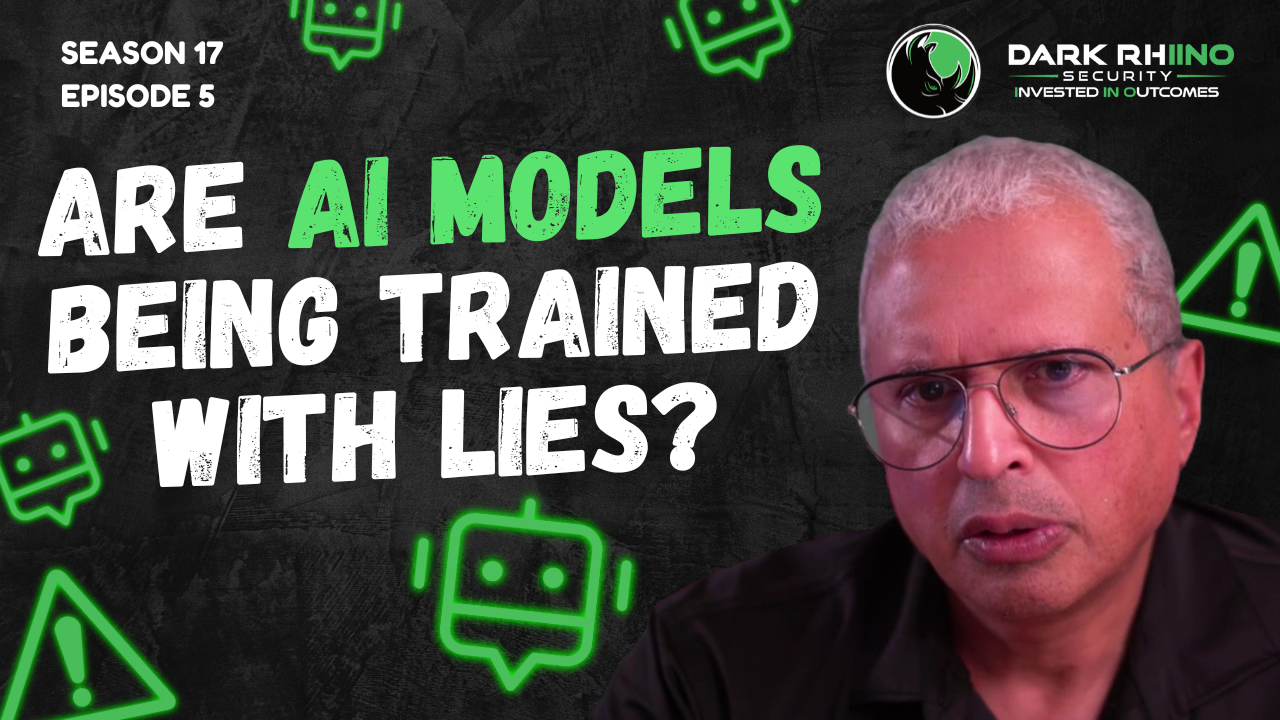
This week on Dark Rhiino Security’s Security Confidential podcast, Host Manoj Tandon talks to Alex Sharpe again. Alex is a board member, practitioner, speaker, and author known for driving value while managing cyber risk. With a career that began in the intelligence community, Alex has since led strategic transformations across global enterprises, built two startups (including one […]
Video
This week on Dark Rhiino Security’s Security Confidential podcast, Host Manoj Tandon talks to Alex Sharpe again. Alex is a board member, practitioner, speaker, and author known for driving value while managing cyber risk. With a career that began in the intelligence community, Alex has since led strategic transformations across global enterprises, built two startups (including one with a successful IPO), and participated in over 20 M&A transactions. Recognized as a top thought leader in cybersecurity, risk management, cloud, and digital assets, he bridges the worlds of business, cyber, and governance to build stronger organizations and better lives.
Are AI Models Being Trained with Lies? | Security Confidential
Chapter Titles:
00:00 Introduction
02:20 Cybersecurity Imposters
05:50 How do we prepare for the future?
12:40 The best investment we can make
18:44 AI Models Collapse
23:00 Training AI Models for malicious intent
Audio
Spotify Embed: S17 E05 Are AI Models Being Trained with Lies?
Important Links
Transcript
Manoj Tandon:
Hello everyone, this is your host, Manoj Tandon. Welcome to another episode of Dark Rhino Security’s Security Confidential. Please hit the Like and Subscribe button so we can get a little bit of love—not just from you, but from the algorithms. They matter more than we’d like to admit!
Today we’re honored to welcome back a Security Confidential alumnus, Mr. Alex Sharpe. For those who missed his previous episode, you really should go listen—we’ll link it in the description.
Alex has been in the industry since the 1980s. He’s worked with multiple three-letter federal agencies, serves on several boards, and is a cybersecurity practitioner, speaker, author, and adjunct professor (when he finds the time—I don’t know how he does it). He’s also led multiple M&As and startups and is a recognized thought leader in cybersecurity and risk management.
Alex, welcome back!
Alex Sharpe:
Thank you for having me. I really enjoy these discussions—they’re always great.
Manoj Tandon:
I’m looking forward to it. Last time we got into some pretty interesting territory, and I’d like to pick up where we left off. You were attending the ISACA conference then—how did it go? Any interesting takeaways?
Alex Sharpe:
Yes, quite a few. I don’t think I’ve ever been to a bad ISACA conference—they’re all good. But one thing that really stood out this time was the discussion around imposter syndrome.
Cybersecurity has become a business conversation. There’s money to spend, so people are gravitating toward the field—sometimes for the wrong reasons. It’s like watching kids play soccer: everyone swarms around the ball instead of playing their positions. Cyber has become “magnet ball.”
There’s fame, fortune, and opportunity—so everyone dives in, whether or not they’re qualified. And while I don’t begrudge anyone for wanting to feed their family, I’ve seen imposters do real damage in this industry and others. Their advice sounds good, but it often hurts the business in the end.
I’m also doing a lot of work around artificial intelligence right now—helping large organizations manage risk and reward. About two years ago, I was on a call with the head of AI research at a major think tank. We were trying to categorize AI risk, which is hard because there’s no established framework yet. Twenty people can be talking about the same thing and using thirty different terms.
That researcher said something that stuck with me: “The only thing growing faster than AI adoption is the number of long-term AI experts.” And he was right. There’s a flood of bad advice coming from people who simply aren’t qualified—and worse, many of them know it and don’t care.
Manoj Tandon:
That’s concerning.
Alex Sharpe:
It is. You can even tell when something’s written by ChatGPT or another tool—it has a pattern. Some advisory work now literally consists of dumping questions into a chatbot.
As an adjunct professor, I tell my students: plagiarism is plagiarism, no matter what tool you use. If you want to use AI for grammar or research, fine. But the ideas must be your own. If you don’t disclose AI use beyond editing, you’ll get a zero.
Manoj Tandon:
How does that go over with your students?
Alex Sharpe:
So far, no one’s argued. We run all submissions through plagiarism and AI-detection tools. None of my students have had issues yet—but the interesting question is how I’ll react if a tool ever flags something as AI-generated.
Manoj Tandon:
That’s a tough spot. I know a few universities dealing with widespread AI-assisted homework and coding assignments. Some students submit perfect projects, but when it’s time for exams, they can’t perform because they never learned the material. How are you and your university adapting to that?
Alex Sharpe:
That’s the challenge. The consensus among faculty is that the only people getting hurt are the students themselves—and they’re paying a lot of money for that privilege. In my case, I teach two courses—Resilience and AI Governance—and soon a third. These don’t rely on traditional exams. Students do quizzes, discussion forums, and papers. It’s not like calculus or physics where you can easily catch inconsistencies. If someone aces every quiz but bombs the exam, it’s obvious. For my subjects, the difference is subtler. I’ve advised colleagues to give exams more weight because they’re in a controlled environment.
I personally dislike exams—I always performed better in the real world—but under current circumstances, they might be necessary.
Manoj Tandon:
That makes sense. In our last conversation, I said, “The man who knows how will always have a job, but the man who knows why will be his boss.” I also said AI breaks that equation because “how” people may become irrelevant. So how do we graduate more why thinkers if students rely on tools for the answers?
Alex Sharpe:
That’s a great point. Honestly, the problem predates AI. Most issues I encounter boil down to two things:
- People don’t ask why they’re doing something.
- They don’t do the homework upfront.
Take code, for example. Someone says, “The code isn’t working.” I ask, “What’s it supposed to do? Why does it exist? What are your expectations?” Often, they’ve skipped those questions entirely.
Too many people jump straight into the syntax—commas, spacing, trivial details—without understanding whether the issue is that the code doesn’t run at all or that it’s off in the twelfth decimal place. Those are very different problems.
AI might actually help us improve this if it forces people to think critically about prompts—why they’re asking what they’re asking and which model they’re using.
Manoj Tandon:
That’s interesting. But education still trains people to repeat “how,” not to explore “why.” And that applies across the board—from trades to medicine.
Alex Sharpe:
True. Humans have operated that way for hundreds of thousands of years. The difference today is the pace of change.
Let’s go back to the caveman era. The most valuable person was the one who could start a fire. Over time, that knowledge spread. Today, we just flick a switch. We’ve transferred the work from human to machine.
Technology always does that—it takes on repetitive labor so humans can innovate. What’s different now is that AI is replacing white-collar work for the first time—knowledge workers, not just manual labor.
Manoj Tandon:
Yes, and that’s uncharted territory.
Alex Sharpe:
Exactly. Historically, every technological shift has caused panic, but we’ve always created more jobs than we’ve lost. The question isn’t whether it’ll balance out—it’s what will it look like this time? We’ve never had disruption at this scale among educated workers.
By the way, fun fact: the word sabotage supposedly came from factory workers in Japan throwing their wooden shoes—sabots—into machines to stop them. Whether or not it’s true, it’s a great story.
Manoj Tandon:
I didn’t know that! I’m definitely using it at my next cocktail party.
Alex Sharpe:
You should! And it ties into my last point—investing in yourself is always the best investment. The younger you are, the more you should explore. Even if you try something and hate it, the experience adds value.
Some people use AI to cut corners; others use it to innovate. For instance, a developer might let AI handle repetitive tasks while they focus on creative problems. That’s the ideal use case—AI should elevate human thinking, not replace it.
Manoj Tandon:
Exactly. That’s when you’re using your mind to create something novel.
Last time you mentioned an Oxford study identifying jobs most at risk from automation—roofers, nailers, and such. Today I read an article about Japan and South Korea heavily investing in humanoid robots for manual labor. Looks like the Jetsons weren’t far off!
Alex Sharpe:
(Laughs) You’re right! We even did a conference panel once comparing futures: George Jetson versus Star Wars versus The Terminator. The George Jetson scenario seems more pleasant.
Manoj Tandon:
Let’s hope it’s not The Terminator version. Still, it’s remarkable how fiction predicts invention. We’re actually seeing humanoid robots emerge now.
Alex Sharpe:
Exactly. Human history has always been about automating the mundane. This is just the next step—though arguably a more dangerous one, because of the pace and potential misuse.
In the Stone Age, if fire went wrong, you smoked up a cave. Today, an AI model could theoretically provide instructions for building a weapon.
Manoj Tandon:
That’s a chilling thought—and once the genie’s out, there’s no putting it back.
Alex Sharpe:
Right. And bias makes it worse. Bias is inevitable, but we have to manage unwanted bias. Some of it’s harmless—like preferring tall players for basketball—but data bias can be discriminatory without us realizing it.
Manoj Tandon:
That’s what worries me about cybersecurity products. Every OEM claims to use AI now—even toilet seats probably have it—but all those models must be biased to some extent.
Alex Sharpe:
(Laughs) I actually saw an AI-enabled toilet once! But yes, you’re right. Since ChatGPT exploded in 2022, everyone feels compelled to say “AI” within 30 seconds of a sales pitch.
To be fair, cybersecurity vendors have used AI for decades—spam filters are a classic example—but marketing has run ahead of reality. There are valid use cases, like analyzing logs for anomalies, but we’re still perfecting them decades later.
Manoj Tandon:
And data bias adds another layer of danger, especially since we already detect only a fraction of incidents.
Alex Sharpe:
Exactly. Most organizations detect maybe a third of their incidents. The rest are found by law enforcement, suppliers, or attackers themselves. That means our detection data is inherently biased—two-thirds of the picture is missing.
Manoj Tandon:
That’s the real danger. The industry still focuses too much on technical controls instead of holistic risk management. Buying the next “AI-powered” gadget can create a false sense of security—like the Titanic’s lookout tower.
Alex Sharpe:
(Laughs) True—and as I like to joke, the difference between us and the Titanic is that the Titanic had a band.
Manoj Tandon:
(Laughs) Well said. Alex, I know you’ve got another meeting. Thank you again for joining us—let’s pick this up next time.
Alex Sharpe:
Absolutely. I love these conversations. Let’s continue them soon—and maybe talk about the Titanic a bit more!
Manoj Tandon:
Sounds great, Alex. Take care.
Alex Sharpe:
Thanks, Manoj. Always a pleasure.
Read more about Alex on his LinkedIn
Check out the other episodes in Season 17:
Ep. 0 Jon DiMaggio – Tracking Cyber Criminals
Ep. 1 John Carse – Why Your Browser Is Your Biggest Risk
Ep. 2 Alex Sharpe – Is Your Job Safe From AI?
Ep. 3 Chuck Brooks – Thinking Beyond the Checkbox
Ep. 4 Henrik Parkkinen – Adapting to AI & Rethinking What We Protect
Ep. 5 Alex Sharpe – Are AI Models Being Trained with Lies?
Ep. 6 Santosh Kaveti – Disaster Recovery Isn’t Optional
Ep. 7 Bob Burke – Think MFA is Enough? Think Again.
Ep. 8 Ed Gaudet – The Biggest Mistakes in Healthcare Security
Ep. 9 Husam Shbib – The Hacker’s Playbook
Ep. 10 Shayla Treadwell – The Psychology Behind Cyber Resilience
About Alex Sharpe

Alex Sharpe is a board member, practitioner, speaker, and author known for driving value while managing cyber risk.
With a career that began in the intelligence community, Alex has since led strategic transformations across global enterprises, built two startups (including one with a successful IPO), and participated in over 20 M&A transactions.
Recognized as a top thought leader in cybersecurity, risk management, cloud, and digital assets, he bridges the worlds of business, cyber, and governance to build stronger organizations and better lives.
About Us
Dark Rhiino Security’s Security Confidential is a weekly Cybersecurity podcast where Host, Manoj Tandon, talks to Infosec and Cybersecurity professionals about the current issues going on in our industry. Guests are able to share their stories about how they began their journey into cybersecurity and connect with our audience. Listeners are able to tune in through Spotify, Apple Podcasts, Google Podcasts, Amazon Music, iHeartRadio, Youtube, LinkedIn, and more.
For inquiries, please email media@darkrhiinosecurity.com
Share and spread the word!
Original podcast listings
Archive source: Original website record. Original wording and artwork retained.