
SECURITY CONFIDENTIAL
Security Confidential S15 E3 Eric Daimler
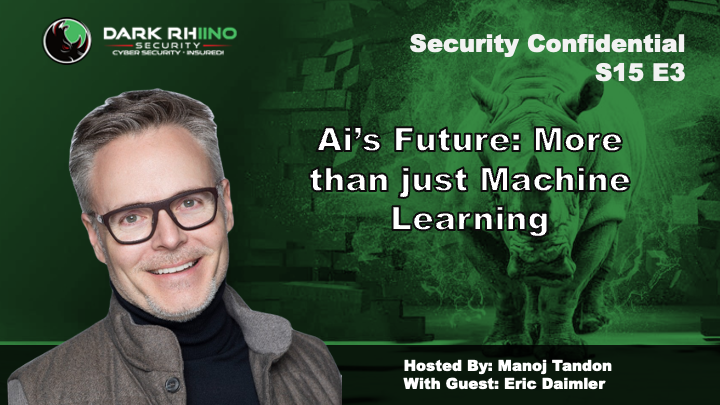
This week on Dark Rhiino Security’s Security Confidential podcast, Host Manoj Tandon talks to Dr. Eric Daimler. Eric is a leading authority in robotics and artificial intelligence with over 20 years of experience as an entrepreneur, investor, technologist, and policymaker. He served as a Presidential Innovation Fellow for AI and Robotics under the Obama Administration, driving U.S. […]
Video
This week on Dark Rhiino Security’s Security Confidential podcast, Host Manoj Tandon talks to Dr. Eric Daimler. Eric is a leading authority in robotics and artificial intelligence with over 20 years of experience as an entrepreneur, investor, technologist, and policymaker. He served as a Presidential Innovation Fellow for AI and Robotics under the Obama Administration, driving U.S. leadership in AI research and commercialization. Eric has founded and led several pioneering tech companies and currently serves on the boards of WelWaze Medical and Petuum. His latest venture, Conexus, addresses the critical issue of data deluge in information technology. With a career spanning business, academia, and policy, Eric offers a unique perspective on shaping the future of AI for societal benefit.
AI's Future: More Than Just Machine Learning | Security Confidential
Chapter Titles:
00:00 Snippet
01:09 Our Guest
05:40 AI is much more than Machine Learning
10:57 Lisp and data 30:54 Conexus
32:53 Type Theory and Quantum compiling
34:44 The government’s role in AI
39:14 Connecting with Eric
Audio:
Spotify Embed: S15 E3 AI's Future: More Than Just Machine Learning
Important Links:
Transcript
Manoj Tandon (00:50.973)
Okay. Hello everyone. Welcome to another episode of Dark Rhiino Security, Security Confidential. Today we have another awesome guest, but before I introduce him, I do want to remind all you guys to please show us some love and like and subscribe. It allows us to create such great content and to keep bringing these world renowned guests to you. And today we do have a world renowned guest. His name is Dr. Eric Daimler.
Dr. Daimler hails from San Francisco currently, but he has a long history with my neck of the woods here in Pittsburgh. He was an assistant professor at Carnegie Mellon University. He was the assistant dean at the School of Computer Science. Currently, he is the CEO of Kinexis, and we’re gonna talk about that, but he’s got over 20 years of experience. He’s served our presidents.
He was in the Obama administration. He was the Presidential Innovation Fellow for AI and Robotics, helped drive a lot of policy, was part of the Columbus Smart Cities program. He’s on the board at Wellways Medical and Petume. We’re honored to have him. Thank you for joining us today. Eric, appreciate you being here.
Eric Daimler (01:57.546)
Thank you for the kind introduction and it’s great to be here.
Manoj Tandon (02:18.408)
Well, you know, let’s start with, you know, our audience always wants to know your beginnings. You know, a little bit about you as a person, how you—was computer science always your thing or how did you arrive in this universe? And are you a sci-fi fan? I want to know that.
Eric Daimler (02:24.718)
Computer science has always been my thing. I had my first computer at a precociously young age, built from a kit. And I chose Carnegie Mellon just because it was the best. I came to Pittsburgh for my very first time in preparation for my first day of classes.
I’ve been computer science bred, I guess you can say. I was originally attracted to it from the robotics side of it that Carnegie Mellon is so well known for. At that time, I had turned down MIT and Stanford to come to Carnegie Mellon because it had such momentum in those domains. And I’m happy I did. It’s been a lovely experience to have spent so many years in Pittsburgh.
Manoj Tandon (03:33.181)
So when you started at Carnegie Mellon, were you part of any of the research into self-driving automobiles that was pioneered here?
Eric Daimler (03:53.198)
I often talk about the history of self-driving cars to contrast the hype that surrounds them. In 1983, you saw the first Navlab on the streets of Pittsburgh doing self-driving.
I wasn’t part of that project. I was working on robot balance earlier. But I had the privilege of having mentors like Raj Reddy and Red Whittaker. Later I went to Stanford and developed an affiliation with MIT, but Carnegie Mellon is still special.
Eric Daimler (04:35.758)
You can’t be in Pittsburgh without being a Steelers fan, right? I’ve had the privilege of seeing them play through connections with minority owners. It’s a lovely place. For anyone who hasn’t been, it’s worth the trip—it’s like nothing I’ve experienced.
Manoj Tandon (05:32.413)
It’s always sold out and always a fun time.
That’s great that you’ve maintained that. And you mentioned Steelers bars in San Francisco—loyalty runs deep.
So, talking about AI—this term is everywhere now. For our audience, if you were to simplify it, what does AI really mean? It’s more than machine learning, right?
Eric Daimler (06:19.118)
The term has evolved. When I started, AI meant research. Once something became practical, it wasn’t called AI anymore.
A useful way to think about AI is something that learns from experience over time. But even that has nuance. Autonomous cars learn about shadows, but they won’t suddenly learn Spanish.
Large language models simulate learning—they don’t truly learn like humans. That distinction matters.
There are two main types of AI: probabilistic (like machine learning and neural networks) and symbolic AI. The popular systems today are probabilistic and inductive—they generalize from examples. But induction has limits.
Symbolic AI is deductive—it uses rules. Each has strengths and weaknesses, and the future lies in combining them.
Eric Daimler (11:41.262)
Symbolic AI struggled historically because it didn’t scale. But advances in mathematics—particularly category theory—have changed that.
Category theory is a kind of abstract math that helps model relationships across systems. It allows us to represent complex, multi-dimensional relationships more effectively than traditional graph theory.
Manoj Tandon (14:15.773)
So is this similar to categorization or taxonomy?
Eric Daimler (14:22.222)
It’s related, but more advanced. Think of it as capturing relationships across many dimensions.
For example, you and I are connected through this podcast and through Pittsburgh. Those are different types of relationships. Category theory lets us model that richness.
We’ve applied this to databases—allowing knowledge transfer between systems. For example, transferring insights from one aircraft design to another without starting from scratch.
Manoj Tandon (18:07.197)
So in simple terms, it helps connect and infer relationships across different data models?
Eric Daimler (18:43.47)
Exactly. And not just infer relationships, but also detect contradictions.
For example, in designing an oil well, multiple experts contribute different models. Today, that coordination happens manually. AI can ingest those models and reconcile them far more efficiently and reliably.
Manoj Tandon (21:39.453)
That’s fascinating. Could this apply to drug discovery?
Eric Daimler (24:36.366)
Today, it still requires human experts. AI can help generate queries and validate results, ensuring accuracy and eliminating hallucinations.
The key value is making AI outputs trustworthy—what we call “safe AI.”
Manoj Tandon (27:11.165)
There’s a lot of hype around AI becoming sentient.
Eric Daimler (27:31.95)
That’s overblown. What matters is how convincingly systems simulate intelligence and how powerful they are—not whether they’re truly conscious.
Humans remain essential for interpretation and context.
Eric Daimler (29:48.91)
The biggest risk is being surprised by automation. Skills now have shorter lifespans. The best defense is to actively use AI and stay ahead of it.
Manoj Tandon (30:29.117)
That’s an accelerated disruption compared to the past.
Eric Daimler (31:05.39)
Exactly. The difference now is speed. Once something works, adoption can be immediate and widespread.
Manoj Tandon (31:46.589)
What is Kinexis focusing on?
Eric Daimler (32:13.454)
We focus on critical infrastructure and safe AI—particularly validating SQL queries generated by AI systems to ensure trustworthy results.
There’s a lot of talk about AI safety, but few technical solutions. That’s what we provide.
Manoj Tandon (33:12.221)
Where can people learn more about category theory?
Eric Daimler (33:23.84)
My co-founder David Spivak has written excellent books on the subject. We also sponsor a conference at Oxford. It’s a growing field with applications in quantum computing and blockchain.
Manoj Tandon (35:36.957)
What about government regulation?
Eric Daimler (35:37.294)
Governments should focus on practical measures like data lineage and transparency rather than overreaching policies.
We also need “circuit breakers” in automation—intentional controls to prevent unintended consequences.
Manoj Tandon (40:29.117)
Final thoughts or plugs?
Eric Daimler (40:06.542)
Check out connexis.com or sql.ai to explore safe AI and query validation. I’m also active on LinkedIn.
Manoj Tandon (40:45.853)
Eric, it’s been a pleasure. Thank you for your time and insights.
Eric Daimler (40:51.758)
It was a great conversation.
Manoj Tandon (41:10.493)
Thank you so much.
Eric’s Linkedin
Learn more about Conexus Ai
Check out the other episodes in Season 15:
Ep.0 Robert Kerbeck – Fame, Fortune, and Corporate Espionage
Ep. 1 Stephen Kowski – Inside the mind of a Field CTO
Ep. 2 Vivek Ramachandran – Inside Email Security: Breaking Through Gmail and Outlook’s Defenses
Ep. 3 Dr. Eric Daimler – AI’s Future: More Than Just Machine Learning
Ep. 4 Purandar Das – Data is the New Oil
Ep. 5 Aaron Painter – Understanding Deepfakes
Ep. 6 Jake Moshenko – Navigating Open Source and Distributed Systems
Ep. 7 Nick Espinosa – Why CISOs Must Master Nerd to English Translation
Ep. 8 Dan Lohrmann – AI, Fraud, and the Future of Cybersecurity
Ep. 9 Greg Schaffer – How the Role of a vCISO is changing
Ep. 10 Sanjay Chopra – AI Innovations and the Future of Automation
About Dr. Eric Daimler

Dr. Eric Daimler is a leading authority in robotics and artificial intelligence with over 20 years of experience as an entrepreneur, investor, technologist, and policymaker. Eric served under the Obama Administration as a Presidential Innovation Fellow for AI and Robotics in the Executive Office of President, as the sole authority driving the agenda for U.S. leadership in research, commercialization, and public adoption of AI & Robotics.
Eric has incubated, built and led several technology companies recognized as pioneers in their fields ranging from software systems to statistical arbitrage. Currently, he serves on the boards of WelWaze and Petuum, the largest AI investment by Softbank’s Vision Fund. His newest venture, Conexus, is a groundbreaking solution for what is perhaps today’s biggest information technology problem — data deluge.
Eric’s extensive career spanning business, academics and policy give him a rare perspective on the next generation of AI. Eric sees clearly how information technology can dramatically improve our world. However, it demands our engagement. Neither a utopia nor dystopia is inevitable. What matters is how we shape and react to, its development.
About Us:
Dark Rhiino Security’s Security Confidential is a weekly Cybersecurity podcast where Host, Manoj Tandon, talks to Infosec and Cybersecurity professionals about the current issues going on in our industry. Guests are able to share their stories about how they began their journey into cybersecurity and connect with our audience. Listeners are able to tune in through Spotify, Apple Podcasts, Google Podcasts, Amazon Music, iHeartRadio, Youtube, LinkedIn, and more.
For inquiries, please email media@darkrhiinosecurity.com
Share and spread the word!
Original podcast listings
Archive source: Original website record. Original wording and artwork retained.