
SECURITY CONFIDENTIAL
Security Confidential S15 E10 Sanjay Chopra
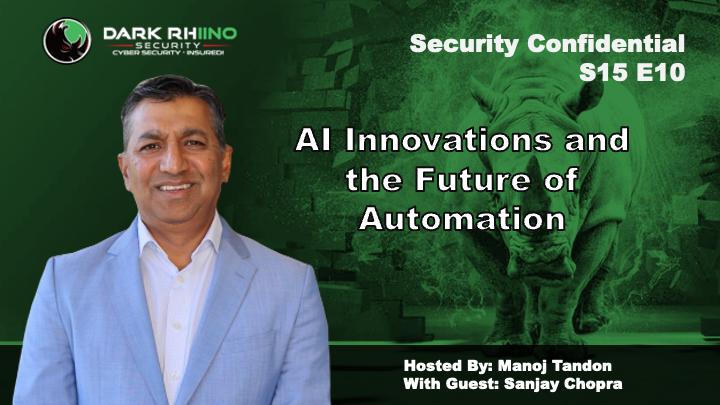
This week on Dark Rhiino Security’s Security Confidential podcast, Host Manoj Tandon talks to Sanjay Chopra, Sanjay is the co-founder and CEO of Cognistx, an AI company known for developing innovative products like SQUARE and DQE, used across various industries. With over 30 years of experience in AI and business strategy, Sanjay has led several successful technology […]
Video
This week on Dark Rhiino Security’s Security Confidential podcast, Host Manoj Tandon talks to Sanjay Chopra, Sanjay is the co-founder and CEO of Cognistx, an AI company known for developing innovative products like SQUARE and DQE, used across various industries. With over 30 years of experience in AI and business strategy, Sanjay has led several successful technology ventures. He serves on the Pittsburgh board of the Federal Reserve Bank of Cleveland and is involved in multiple technology councils and advisory boards. Sanjay holds advanced degrees from Carnegie Mellon University and Virginia Tech, and he also teaches e-commerce as an adjunct professor at Carnegie Mellon.
AI Innovations and the Future of Automation | Security Confidential
Chapter Titles:
00:00 Intro
01:04 Our Guest
10:15 Changing the AI threat landscape
17:40 Using AI to complete legal work
27:10 Will AI remove the human element?
47:08 What does CognistX do?
50:00 SQUARY and Dark Rhiino’s vCISO Bot Launch
Audio:
Spotify Embed: S15 E10 AI Innovations and the Future of Automation
Important Links:
Transcript
Manoj Tandon (00:00.723)
Hello everyone, this is your host Manoj Tandon with another episode of Dark Rhiino Security, Security Confidential. Today we have another great guest. He also happens to be a friend of mine and we do business with his company as well, just so you all know. Full disclosure there, but it’s Sanjay Chopra. Sanjay is a great golfer. He can knock the ball 300 yards, but when he’s not doing that, he’s the CEO of Cognistics.
And when he’s not doing that, he is on the Federal Reserve Bank Board in Cleveland, Ohio. He is a Carnegie Mellon grad, has several degrees. He teaches e-commerce as an adjunct professor at Carnegie Mellon. He’s just a very smart guy and we’re honored to have him here. Sanjay, thank you for taking your time for us today.
Sanjay Chopra (00:58.183)
Of course Manoj, it’s a pleasure. It’s a pleasure to be with you. It is a pleasure to know you and you are awesome to golf with and I’m looking forward to this conversation.
Manoj Tandon (01:05.437)
See now, as soon as you said that, everybody that knows me is gonna say, now we know all credibility is lost. Because they know I usually go for a walk and golf gets in the way of it, whereas you actually golf and the walk gets in the way of it.
Sanjay Chopra (01:24.504)
But you know, there are two types of golfers. One who would be really good and can be fun to play with, or people who may not be that good but are still a lot of fun to play with. So it’s important to be fun to play with.
Manoj Tandon (01:36.151)
I agree with you wholeheartedly. The serious crowd, I’m kind of out of. But for our audience, everybody loves the origin story. So we want to start there. Give us your background. Before you were CEO of Cognistics, what were you doing? And how did this all happen? Like, how did your career progress?
Sanjay Chopra (02:08.584)
Absolutely, I’d be happy to. So it should be a surprise—I grew up in India and my dad was actually in the Indian Army. So I grew up all over India. So it was quite an experience of getting to meet new people, getting to travel different parts of the country, see everybody.
One of our postings—that’s what we call them in the Army—I got introduced to a computer and I was able to spend some time in eighth and ninth grade and really play with it and program it in BASIC and other things. Me and my brother used to sit together every time, every opportunity we got. We started programming, we made a car racing game, we made all sorts of fun stuff, and we really got engaged into it.
And that sort of dwelled into us getting into engineering colleges. Then both of us came to the US together back in 1990. I went to Virginia Tech, got a master’s in computer science. He went to State University of New York, Buffalo. About two months after the fall session, he calls me and tells me, this place is really cold.
Manoj Tandon (03:15.699)
Compared to India? Yes. I know, but I assume that from India, Buffalo is a polar opposite—it’s actually polar.
Sanjay Chopra (03:33.93)
It really is. But Virginia was a beautiful place and I really got more into computer science, more into programming. Came to Pittsburgh, worked for a company called Carnegie Group. That was also a spin-off of Carnegie Mellon University. So we were actually doing AI before AI was popular, under Dennis Yablonsky and some of the people, Raj Reddy, Dr. Raj Reddy.
And I was working on a Department of Defense project. Eric Nyberg, who also is my co-founder at Cognistics, he was working on the Caterpillar project. So we were both in the same organization almost 30 years ago.
Since then, I got another master’s at business school at Tepper at Carnegie Mellon.
Manoj Tandon (04:21.523)
So you’re a full-time student. You just couldn’t—
Sanjay Chopra (04:27.086)
Full-time student, yes, I love going to school. So after that degree, I actually got $18 million in venture money and started a company called Online Choice. So we were aggregating demand for essential services.
Then we started another company, Intelliance, where we were able to sell the IP and technology to Google. One of the patents we had was based on time and location doing the search—so find a pizza place close to me on my cell phone—and we had a patent on that.
Manoj Tandon (05:01.028)
You’re responsible for all the privacy problems.
Sanjay Chopra (05:07.438)
We just filed a patent, and obviously Facebook and everybody else wanted to get that technology. We ended up selling it to Google.
Then I was at Giant Eagle and IBM, where we were helping build Watson and also Curbside Express and some of the other projects at Giant Eagle. But then I got bored. I said, we got to start another company again. And we started Cognistics with Eric.
It’s been nine years. We started initially as a bespoke AI company where we were doing custom AI applications. We quickly figured out that’s not a very scalable model—it’s human capital intensive. Since then, we’ve had a couple of great products: a data quality engine and Square, now which has morphed into Squarey, which we are deploying with you guys as well. It’s all based on natural language processing.
Manoj Tandon (06:25.637)
That’s actually a very short answer because I have a couple follow-up questions on this. Out of curiosity, that first computer—what was it that you and your brother were playing with?
Sanjay Chopra (06:40.11)
So it was DOS and then an Atari system. We hooked it up to an Atari system to do games and gaming.
Manoj Tandon (06:47.089)
That’s awesome. When you started with AI at CMU, back then we did not have the compute power that we do today—not even close. We didn’t have a lot of the functional applications available now. Back when I looked at it in the early 90s, a lot of it was Lisp. Did you?
Sanjay Chopra (07:33.006)
Programmed in Lisp initially, and then we moved to C++ and object-oriented databases. A lot of it was C programming.
What has really happened in the last six or seven years is a few things: cloud has taken off, computing power has improved significantly, computer vision has come a long way, and word error rate has improved. Computers can now understand speech extremely well. And recently, large language models like GPT have emerged, being able to answer questions based on massive information.
Manoj Tandon (09:19.439)
Those expert systems—it was like programming chess, right? So how—what do you mean when you say computers understand us better? Do you have any idea what the error rate is?
Sanjay Chopra (09:48.494)
99.97% for computers.
Manoj Tandon (09:48.711)
Really.
Sanjay Chopra (09:56.264)
Also can deal with context very well. Computers are trained on so much data now that they can predict what word you’re going to say next.
Manoj Tandon (10:51.517)
So let’s look at this in the medical industry. Has it gotten good enough where the error rate on something like an MRI is better than a human?
Sanjay Chopra (11:24.17)
In certain instances, it actually is better. For lung nodules, computers can detect patterns faster than humans can.
Manoj Tandon (11:52.22)
Radiologists aren’t going to like that answer.
Sanjay Chopra (12:01.656)
The idea is to make them better, not replace them. AI can triage and prioritize cases so humans can validate and act faster.
Manoj Tandon (13:18.584)
Coming from aviation, automation has caused failures. If someone told me we’d have a pilotless airplane, I wouldn’t get on it.
Sanjay Chopra (14:30.626)
Even now, systems can do almost everything, but you still want a human there to take over.
Manoj Tandon (15:35.791)
Are we creating a condition where humans will second guess themselves because of AI?
Sanjay Chopra (16:14.03)
Hopefully not. It’s a tool to assist, not replace.
Manoj Tandon (16:22.427)
There’s a danger people rely on it too much.
Sanjay Chopra (17:22.351)
Then systems need checks and balances built in.
Manoj Tandon (18:28.604)
What about hallucination?
Sanjay Chopra (20:10.412)
Hallucination means the AI can make things up. It predicts likely answers but may be wrong. You reduce that by training on the right data and setting constraints.
Manoj Tandon (22:22.951)
What prevents it from just saying “I don’t know”?
Sanjay Chopra (22:46.286)
You can instruct it to only answer if it knows. Otherwise say “I don’t know.”
Manoj Tandon (24:15.619)
That’s a good answer.
Sanjay Chopra (24:27.534)
I wish more humans did that.
Manoj Tandon (28:45.715)
Let’s talk about AI in cybersecurity.
Sanjay Chopra (28:58.702)
AI can detect anomalies in network traffic, predict breaches, analyze dark web data, and help prevent attacks before they happen.
Manoj Tandon (31:12.957)
Does that get into Minority Report territory?
Sanjay Chopra (31:32.172)
It depends on how responsibly it’s used.
Manoj Tandon (32:30.271)
Why not use AI to simulate real-world breaches?
Sanjay Chopra (34:05.506)
That’s a great application—run simulations, predict vulnerabilities, and improve defenses.
Manoj Tandon (35:37.757)
Can we do that today?
Sanjay Chopra (35:45.878)
Yes, the compute power exists.
Manoj Tandon (36:25.52)
What about the dark web?
Sanjay Chopra (36:36.416)
Huge applications—tracking stolen data, predicting fraud, identifying threats early.
Manoj Tandon (39:07.835)
How do you train these systems?
Sanjay Chopra (40:28.726)
Show massive datasets, train models, test predictions, refine continuously.
Manoj Tandon (42:40.753)
What about data leakage with tools like Copilot?
Sanjay Chopra (42:59.63)
You need guardrails—control what data is shared and how it’s used.
Manoj Tandon (45:10.991)
What does Cognistics do?
Sanjay Chopra (45:18.318)
We clean data, then apply AI. Our product Squarey lets users query documents, websites, and knowledge bases using natural language.
Manoj Tandon (47:47.136)
Can it be deployed privately?
Sanjay Chopra (47:57.326)
Yes, fully private cloud deployment.
Manoj Tandon (49:41.373)
What are the limitations of AI?
Sanjay Chopra (49:57.122)
High compute cost, complexity, and difficulty updating models.
Manoj Tandon (52:08.359)
Where is it going?
Sanjay Chopra (52:14.84)
Faster, more powerful, more integrated—speech, vision, text all combined.
Manoj Tandon (52:32.652)
Final thoughts?
Sanjay Chopra (54:06.784)
Use technology safely and effectively.
Manoj Tandon (54:49.959)
Sounds like great advice. Thank you, Sanjay.
Sanjay Chopra (54:56.096)
Thank you.
Read more about Sanjay on his LinkedIn
Visit Cognistx

Kiteworks enables organizations to effectively manage risk in every send, share, receive, and save of sensitive content. To this end, they have created a platform that delivers content governance, compliance, and protection to customers. The platform unifies, tracks, controls, and secures sensitive content moving within, into, and out of their organization, significantly improving risk management while ensuring regulatory compliance on all sensitive content communications.
Check out the other episodes in Season 15:
Ep.0 Robert Kerbeck – Fame, Fortune, and Corporate Espionage
Ep. 1 Stephen Kowski – Inside the mind of a Field CTO
Ep. 2 Vivek Ramachandran – Inside Email Security: Breaking Through Gmail and Outlook’s Defenses
Ep. 3 Dr. Eric Daimler – AI’s Future: More Than Just Machine Learning
Ep. 4 Purandar Das – Data is the New Oil
Ep. 5 Aaron Painter – Understanding Deepfakes
Ep. 6 Jake Moshenko – Navigating Open Source and Distributed Systems
Ep. 7 Nick Espinosa – Why CISOs Must Master Nerd to English Translation
Ep. 8 Dan Lohrmann – AI, Fraud, and the Future of Cybersecurity
Ep. 9 Greg Schaffer – How the Role of a vCISO is changing
Ep. 10 Sanjay Chopra – AI Innovations and the Future of Automation
About Sanjay Chopra
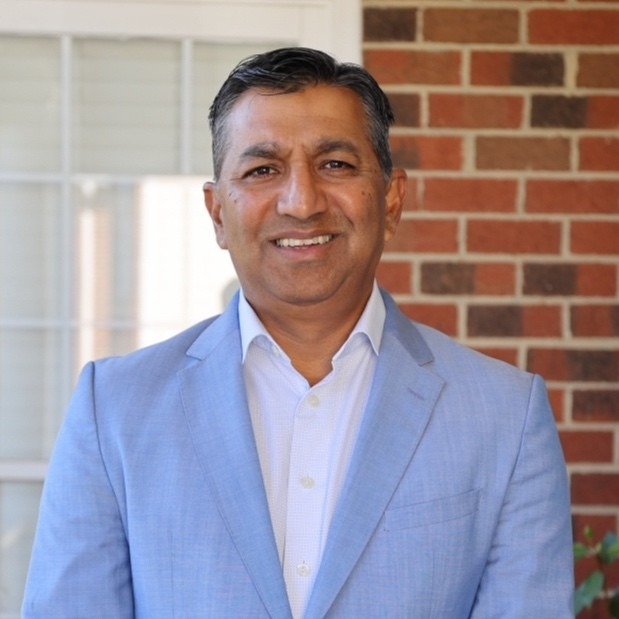
Sanjay Chopra is the co-founder and CEO of Cognistx, a nine-year-old AI company. Cognistx has successfully developed two highimpact AI products, SQUARE & DQE, that work
across several industries. Chopra was also the co-founder and CEO of Intellions; an IP-based internet technology company that has licensed its IP to Google. He has received numerous
accolades, including being named E&Y Entrepreneur of the Year in 2000 for OnlineChoice. Chopra is on the Pittsburgh board of the Federal Reserve Bank of Cleveland and a member of the Technology Council across the entire Federal Reserve System. He was the founding chair of Pittsburgh Social Venture Partners (PSVP) and a founding charter member of the TiE Pittsburgh. He has also worked as a software engineer/manager at Federated Investors, Carnegie Group and Allegheny Management Company.
Chopra is an adjunct professor of e-Commerce at Carnegie Mellon University and holds an MBA from Carnegie Mellon University (GSIA – Tepper Business School), a Master of Science in computer science from Virginia Polytechnic Institute and State University, and a bachelor’s in computer technology from Maulana Azad National Institute of Technology (MANIT – REC) in Bhopal, India. He has also attended the FBI Citizens Academy.
About Us:
Dark Rhiino Security’s Security Confidential is a weekly Cybersecurity podcast where Host, Manoj Tandon, talks to Infosec and Cybersecurity professionals about the current issues going on in our industry. Guests are able to share their stories about how they began their journey into cybersecurity and connect with our audience. Listeners are able to tune in through Spotify, Apple Podcasts, Google Podcasts, Amazon Music, iHeartRadio, Youtube, LinkedIn, and more.
For inquiries, please email media@darkrhiinosecurity.com
Share and spread the word!
Original podcast listings
Archive source: Original website record. Original wording and artwork retained.