
SECURITY CONFIDENTIAL
Security Confidential S1 E1 Luis Martin
This week on Dark Rhiino Security’s Security Confidential podcast, Host Manoj Tandon welcomes Luis Martin. Luis is a world-renowned AI architect and designer joining from Madrid, Spain. With more than 30 years of professional experience, Luis brings deep academic and practical expertise across industrial electronics, industrial design, computer architecture, artificial intelligence, high-performance computing, innovation, cognitive computing, intelligent […]
Video
This week on Dark Rhiino Security’s Security Confidential podcast, Host Manoj Tandon welcomes Luis Martin. Luis is a world-renowned AI architect and designer joining from Madrid, Spain. With more than 30 years of professional experience, Luis brings deep academic and practical expertise across industrial electronics, industrial design, computer architecture, artificial intelligence, high-performance computing, innovation, cognitive computing, intelligent analysis, and advanced technology strategy. In this conversation, he explains the foundations of artificial intelligence, how AI applies to today’s cybersecurity climate, and what organizations need to understand before adopting AI-driven systems.
S1 E1 - Artificial Intelligence
Chapter Titles:
00:00 Intro
0:29 Introducing AI and Guest Expert Luis Martin
2:18 Luis Martin’s 30-Year Background in AI, Computing, and Technology Design
9:01 What AI Can Actually Do Beyond the Buzzword
14:47 How AI Can Strengthen Cybersecurity and SOC Operations
21:54 What Determines AI Project Success, Cost, and Adoption
Audio:
Spotify Embed: S1 E01 - Artificial Intelligence
Important Links:
Connect with Luis on LinkedIn
Transcript
Host: Good morning and welcome to the very first episode of the Dark Rhino Security podcast. In today’s episode, our chief sales strategy officer, Manoj Tandon, will be interviewing world-renowned AI architect and designer Luis Martin about how he got his start in artificial intelligence and how it can be applied in today’s security climate.
Manoj Tandon: Well, I’d like to welcome everybody to the first Dark Rhino podcast. We’re going to be doing a series of podcasts related to cybersecurity, and really one topic that has been at the top of everyone’s mind in the industry is artificial intelligence. You can’t pick up a magazine or a newspaper or any media article without seeing generally some mention of artificial intelligence.
And at Dark Rhino, we are very fortunate to have Luis Martin with us, who is a real expert in this arena. He is going to walk us through what AI is and what we should all think about when we talk about AI. So with that, I would really like to introduce to all of you listening out there Mr. Luis Martin, who is kind enough to join us from Madrid, Spain, where it is currently 11:00 at night. So I hope he’s not sleepy. And Luis, I hope you’ve had an espresso.
Hello. How are you?
Luis Martin: Hello. How are you, Manoj? How do you feel? It’s night in Spain. I am ready for your questions.
Manoj Tandon: Okay, so you want to get right down to business. I like it. So Luis, you know, we’re laypeople when it comes to artificial intelligence, and we thank you for joining us, but before we get into the topic, I think it would serve some of our listeners if you could give a little bit of a background. Just introduce yourself, your years in the industry, your training as a technologist, and some of your background would be very, very helpful.
Luis Martin: Okay. My academic and professional driving has been developed continuously in my more than 30-year professional practice. Academically, I did master’s degrees in industrial electronics at the Polytechnic Institute of Madrid and as an industrial technical engineer specialized in industrial design at the Catholic University.
From there, I have developed several master’s degrees in computer architecture, artificial intelligence, high-performance computing, and innovation and technology management, together with many other courses in intelligent analysis, technological product design, marketing, and strategic sales of high technology, cognitive computing based on Lisp and Prolog, and many other classified courses.
Manoj Tandon: Wow, that is quite a resume there, Luis. That’s a long history. Yeah.
You know, some of these words I can’t even pronounce. So I will defer to you. But when you think of AI and all the things that it means, and we see a lot of it thrown out there in the industry, you know, I have to believe this is a field in which you just can’t get into.
You’ve made many master’s degrees and you’ve studied computer architecture, artificial intelligence, and high-performance computing, but this is not something you just pick up by book learning. I’m sure you’ve had certain mentors and people that have been a heavy influence on you in the field of AI. Could you guide us through maybe a little bit of your background in that arena?
Luis Martin: I have had many teachers and mentors in the field of AI, but I have to highlight some of the founding fathers of the discipline: Marvin Minsky, Seymour Papert, David Moon, Danny Hillis, and especially the impact of the humanistic vision of AI via Margaret Boden and Alan Turing for their visionary character and scientific rigor.
I want to make a special mention of Dr. Karli, a prominent neuroscientist in my country and director of special projects for many years at IBM, with whom I was able to collaborate on several occasions and have constant guidance in my academic approach to the original purpose of AI, which is no other than using computer simulation to study the nature and behavior of human intelligence.
Manoj Tandon: Wow. So would it be fair to say that you have been in AI, Luis, since a very early stage, since the very beginning?
Luis Martin: I think that applied AI is something recent. I have to say that I have been applying AI approaches and techniques for 30 years. I especially remember my first job was the design of a microclimate prognosis based on an AI itself developed by a British company called HELK, Help Uncover Latent Knowledge.
From the professional point of view, I participated in the design and development of many projects where AI had a relevant role. As a sample, the following ones: the design of the monitoring and control system of the Barcelona Metro, based on a mixed approach of inference engines based on rules and neural networks; the design of the monitoring system of the control of the mine at the central power station of As Pontes in Endesa; the intelligence system of the coastal surveillance images for the Spanish army based on the Lisp machine of the pioneer company Symbolics; the Barely flight planning and control system based on logical programming or restrictions based in Prolog; the design of the Edison real-time intelligent network management system based on the inference engine of Talarian, a company created by my friend Tom Lafleur from his monitoring work on the ground control system of the Hubble telescope.
Other samples are systems of analysis of religious phenomena and studies of polemology of conflicts for the general staff of the army based on a combined model of expert systems based on rules and a multi-layer neural network; the design and implementation of a supercomputing service for the energy and aerospace industry based on a vector supercomputer and a neuronal cluster supercomputer at Fujitsu company; other research projects such as the Cinderella research project from the European Union, aimed at creating a standard manufacturing model based on AI; for the security field, the project of phishing analysis for the BBVA bank security department using evidence extraction and link discovery algorithms and automatic reasoning; and finally, the design and development of an open-source intelligent collection and pre-analysis system for the Homeland Security Ministry based on entities, natural language understanding, natural language processing, ontologies, and Bayesian algorithms, as well as other R&D projects that by their nature and application are confidential and classified at this time.
Manoj Tandon: So Luis, that is quite an extensive list of projects that you have worked on. You know, one of the things that, again in the popular literature and in popular culture, what we see is that AI is a buzzword. Typically when we think of it, we’ve heard of machine learning. We have heard in Hollywood where computers and robots take over the world and take over mankind, and AI is that kind of technology that’s going to make human beings obsolete.
But in reality, what are some of the general capabilities of AI that can be executed today?
Luis Martin: Okay. Yes. There is an old British motto that says: “Heresy of the past, orthodoxy in the present.” In my experience, when a discipline passes from the science of computing to the computer business, its foundational principles and its knowledge are perverted, and its application can be in many cases confusing and even counterproductive.
Indeed, AI is fashionable and there is a lot of talk, yet too little is known. Artificial intelligence is a scientific technical discipline of the late 20th century, but it had its origin and foundation in the work of people like Alan Turing and John McCarthy, the founding fathers of AI. In the last century, the mathematical computational base is more than 40 years old, including approaches based on neural networks.
Manoj Tandon: So Luis, you know, on that note, it seems like, just listening to you, neural networks come up, neuroscience has come up, mathematical computing, high-performance computing. These are all words that you have used, and it seems like AI is more than just a methodology. It is a combination of multiple disciplines. Is that correct? Is my understanding correct from what you have said?
Luis Martin: Yes. Artificial intelligence is a multidisciplinary discipline.
It has as its mother disciplines: neuroscience, cognitive psychology, mathematics, evolutionary biology, cybernetics, knowledge theory, and of course, computer science. From the point of view of this field of action and following the vision of the aforementioned Margaret Boden, she says that the field of action of AI refers to understanding natural language.
Understanding natural language is nothing more or less than understanding something that, from the point of view of the theory of knowledge, is the Holy Grail. It also implies automatic reasoning through the combination of learning abilities, creativity and problem solving, sensory detection and vision, touch, hearing, flavor, and smell, and the conversion of this into manipulable knowledge.
The establishment of meta-knowledge and managing common sense. Ultimately, the main vision of AI is to create a theoretical framework and a set of techniques and tools to build and implement systems and organizations with intelligent behavior.
Defining what is intelligent behavior in a system and in an organization will be the object of a specific treatment. Although in a very summarized way, I will say that intelligent behavior implies the ability to be able to justify and explain any process of reasoning and decision.
Manoj Tandon: So Luis, that’s very interesting. Natural reasoning, cognitive processing—these are all, in some respects, human traits, and you are talking about a science and techniques that can, to some degree, mimic those human traits.
That being the case, you know, if we in future series can get into more details on specifically the mechanisms of that mimicry and how they take place, but I think, looking at us at Dark Rhino, we’re kind of focused on cybersecurity.
And if I take cognitive processing or natural language processing and reasoning, what kinds of problems in security can those techniques solve?
Luis Martin: Yes. One of the capabilities that intelligent AI-based cybersecurity systems can offer is the ability to understand what is happening and adapt its behavior and respond to the time needs that are handled in cyber speed: critical real-time of milliseconds or nanoseconds.
In cybersecurity, an AI-based system allows detecting and analyzing the nature of vulnerabilities, threats, and attacks, identifying and classifying their behavior with the aim of providing early warning about the risk of being attacked.
Adapting through learning and being able to offer an integral response in terms of protection, intervention, and deterrence in time for planning, decision, and action.
Manoj Tandon: Luis, thank you for giving that elaboration, but when I hear you use the term real-time and milliseconds and nanoseconds, these systems seem like something that is going to be complex. It is going to require exceptional computational power, and to me, it relegates the real work of cybersecurity and AI into the realm of governments and agencies that have huge budgets.
Have there really been any cybersecurity projects that have been outside the realm of government, defense, and intelligence agencies that have been successful or have been applied in the commercial space?
Luis Martin: Yeah. Artificial intelligence is beginning to be successfully applied in the first instance by software manufacturers and cybersecurity service providers such as Darktrace, Jask, or EclecticIQ, including in their functionalities deep learning capabilities for detection and classification of patterns or threats, and inferential analysis for the weighting of risk alerts based on cyber evidence.
This is allowing them to offer preventive security and adaptability to new cyber weapons and new types of attacks. However, there is not yet an extensive application of AI in the SOC of the business organization regarding a study and a sales strategy in terms of which security procedures can be better managed by a virtual operator versus a human operator, the organizational improvement and cost reduction that the extensive application of AI can produce, and finally, how AI can be used to help the operator and the cybersecurity director as a filtering element and expert advice.
Manoj Tandon: Wow. So you’re in essence saying that there’s a big opportunity in SOCs of business organizations and a potential ability to have a virtual operator versus a human being.
Luis Martin: Absolutely.
Manoj Tandon: That’s very, very advanced. And quite frankly, it seems like a sci-fi scenario. But when you look at the organization in most of the commercial companies that are running SOCs or have security operations centers of any kind, they are in the IT organizations.
And what we have—at least some of the observation has been that a lot of the IT organizations don’t have—what’s the best term to use here—the structure to support these kinds of advanced approaches because they do require a degree of experimentation, a degree of innovation, and maybe a degree of flexibility that are outside the norms of very typical IT functions.
So what are your thoughts on structure there, or how do IT teams become successful, or how are they organized to adopt AI in their commercial spaces?
Luis Martin: Okay. In my humble opinion, the first thing that has to be done is a detailed study of the current situation of the system and the IT organization in terms of which challenges have to be responded to in the short and medium term.
Which missions are currently being developed? How AI could improve the operational efficiency and offer new capabilities to the users of the IT system. In short, define a strategic plan and application of AI to the systems and functions that the IT department of the company is offering based on the diagnosis of this situation.
With the established plan, personal training, projects, and improvement on the current applications or the development of new IT applications will be made specific.
Manoj Tandon: Wow. So Luis, what in essence you’re saying is that any company that’s really looking to adopt artificial intelligence should look at the short- and medium-term risks first.
After they evaluate those risks, really look at how the IT organization currently is addressing it and what new capabilities would be required to fill any gaps with AI-based technologies. And then from there, look at the training of the personnel and the resourcing, and look at what AI projects could potentially be successful, which really begs the question: What is the number one factor in determining if an AI project will be successful or not?
Luis Martin: There are many possible factors, but if I have to highlight the most important, in my opinion they are the following:
One, that the team in charge of implementing the AI system have an extensive and in-depth knowledge of all the methodologies, techniques, and tools that AI currently has, and an accredited experience in high-level design of an intelligent system. A low-level domain of the software tools can be used for their implementation.
Two, sufficient training and clear vision by the users of the capabilities that AI can offer to solve their problems, which allows them to manage realistic expectations about its application in the present and in the future.
And finally, three, a clear and consistent project plan of where, how, and in what to apply AI for the different needs of the organization.
Manoj Tandon: So Luis, in this regard then, it seems like AI projects are not that dissimilar to executing any other IT project, where you do need a knowledgeable team and you do need to have them be sufficiently trained, and realistic expectation setting is key to the success of any program out there, and then having a clear plan of execution.
In that regard, there’s nothing different on the AI front, which then brings the question: there is a lot of availability of commercial off-the-shelf software, and why should a company not go and buy commercially off-the-shelf software versus build an internal technology in a bespoke program?
Luis Martin: Yeah. I believe that there is no dichotomy between the two options. I think adopting base software from reference manufacturers that have ample references to success to offer a quick response to needs common to all organizations is not incompatible with adopting a strategic plan or R&D to develop their own capabilities in AI.
No one has doubts that information technology is a fundamental driver of the efficient management of an organization. Core technologies such as AI and information analysis are differentiating elements that are going to allow an organization to have an informative, strategic, and operational superiority over its competitors.
Therefore, the adoption and implementation of a technological strategic plan on the application of AI to specific needs and challenges of the company can be a key factor in its competitive differentiation and its performance.
Manoj Tandon: Well, Luis, with your claim that AI can be a competitive differentiation for any organization potentially, what’s limiting the adoption of AI today?
Luis Martin: In my opinion, I think there are several elements to consider.
Firstly, the confusion from the invasion of information about the capabilities, use, and release of AI by the media.
Secondly, the lack of knowledge of the managers of the organization about the possibility of using AI and the strategic impact on their business.
And finally, the excess of technicians who manage one or two AI techniques and tools, and a lack of designers and technological strategists who know how to design and model an intelligence system and lead a project in coordination and permanent dialogue with senior management, making it very clear that the goal of any project based on AI aims to make the organization more intelligent, more adaptive, efficient, productive, and self-repairing.
Manoj Tandon: You know, one thing here I would say, Luis, in addition to what you’ve just stated on the knowledge gaps that may be present in an organization—which can be rectified with training and the obtaining of the correct resources—is also costs, right?
And costs always become a big factor in any conversation with any system, especially a highly advanced, innovative system. What has been your experience on the typical order of magnitude of costs involved with undertaking an AI project internally in a company?
Luis Martin: Yeah, in my experience, in general terms, the costs are similar to any IT system. If we talk about improving the functionalities of existing applications, we can talk about tens of thousands of dollars. If we talk about creating a new application, we can talk about hundreds of thousands of dollars.
But if the idea is to establish a strategic plan for the implementation of AI in the present and future systems of the organization, we will be handling millions of dollars.
I just want to add to this that, in my opinion, the ROI of the investment will be notably higher at the quantitative level and qualitative level in the latter case rather than in the implementation of skills or tools partially and separately.
One of my lines of work at this moment is to establish the ROI indicators of an intelligent organization versus a traditional organization.
Manoj Tandon: Well, Luis, thank you for that. I can tell you that we’re coming up upon a break here. I think we’ve reached the end of our time. Thank you deeply for taking the time to talk to us today.
And we’ll pick up the conversation in the next series in this podcast on maybe some use cases that you have seen that have been very successful, some anecdotal stories and evidence that you can speak to about how other companies may have used AI.
You mentioned several that are of interest: the management of the train system, the monitoring of the shoreline system, the management of the flight systems. These are all wonderful ideas, and I’m sure that many derivative applications can be made.
Maybe we’ll pick up in the next series on that topic and dive into greater depth. Thank you so much. Hope you have a good night.
Luis Martin: Okay, Manoj. Thank you very much, and I am at your disposal.
Manoj Tandon: Thank you.
Host: Well, thank you for joining us on our inaugural podcast episode. Make sure to hit that subscribe button and check us out at darkrhinosecurity.com.
Check out the other episodes in Season 1:
Ep. 0 DRS Team – Cybersecurity Conferences
Ep. 1 Luis Martin – Artificial Intelligence
Ep. 2 Stefan Ludlow – Personal Responsibility in Cybersecurity
Ep. 3 Tyler Smith – C-Suite- How to fall in love with Cybersecurity
Ep. 4 Jordan Fulk – Bourbon and IT Talent
Ep. 5 Tyler Smith and Manoj Tandon – Zoombombing, Privacy, and Working from home
Ep. 6 Mitch Spaulding – Alternative Paths to a Cyber Career
Ep. 7 Karen Hough – How to build resilience, adapt to obsticles, and thrive
Ep 8. Dakota Rae – Swim with Sharks and Thrive
Ep. 9 Tyler Smith – Tips on Implementing EDR
Ep. 10 Chris Cazel – Learning Okta
About Luis Martin
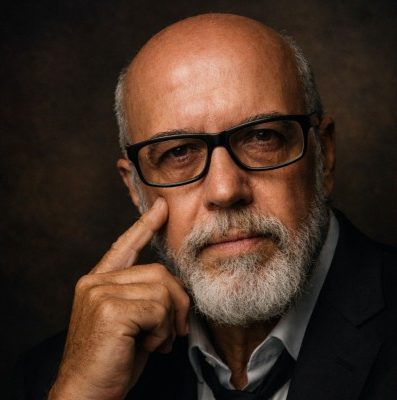
Luis is a world-renowned AI architect and designer joining from Madrid, Spain.
With more than 30 years of professional experience, Luis brings deep academic and practical expertise across industrial electronics, industrial design, computer architecture, artificial intelligence, high-performance computing, innovation, cognitive computing, intelligent analysis, and advanced technology strategy
About Us:
Dark Rhiino Security’s Security Confidential is a weekly Cybersecurity podcast where Host, Manoj Tandon, talks to Infosec and Cybersecurity professionals about the current issues going on in our industry. Guests are able to share their stories about how they began their journey into cybersecurity and connect with our audience. Listeners are able to tune in through Spotify, Apple Podcasts, Google Podcasts, Amazon Music, iHeartRadio, Youtube, LinkedIn, and more.
For inquiries, please email media@darkrhiinosecurity.com
Share and spread the word!
Original podcast listings
Archive source: Original website record. Original wording and artwork retained.