SECURITY CONFIDENTIAL
Security Confidential S3 E8 Jordan Graham
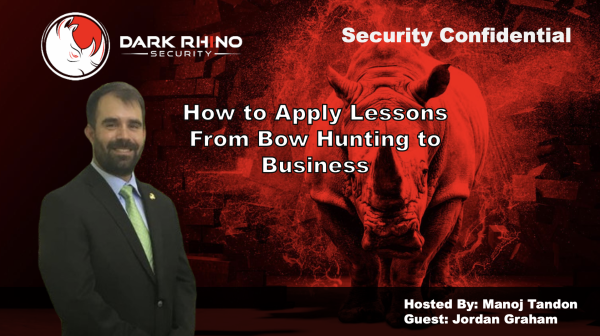
This week on Dark Rhiino Security’s Security Confidential podcast, Host Manoj Tandon welcomes Jordan Graham. Jordan has been in the cybersecurity business for over 3 years and a six sigma black belt. He is a former Marine with an extensive background in process management. Jordan is an avid Bowhunter and is a participant on the podcast “The […]
Video
This week on Dark Rhiino Security’s Security Confidential podcast, Host Manoj Tandon welcomes Jordan Graham. Jordan has been in the cybersecurity business for over 3 years and a six sigma black belt. He is a former Marine with an extensive background in process management. Jordan is an avid Bowhunter and is a participant on the podcast “The Bowhunters Heritage”. In this episode of Security Confidential, Jordan discusses how his learnings and techniques as a bowhunter apply to cybersecurity.
Business Lessons from a Bowhunter
Chapter Titles:
00:10 Introduction
01:44 Why Bowhunting?
07:09 Overcoming a disadvantaged position, Cyber Insurance!
13:32 The objective SWOT analysis to get the highest chance for success
17:39 The hunter’s mentality for business success
19:50 Be decisive
22:14 Turning a disadvantaged position to an advantaged one
25:47 Addressing unknown-unknowns in cybersecurity
32:01 The role of patience in threat hunting
37:20 Lessons from the Marine Corps
44:32 The Bowhunters Heritage
Audio:
Spotify Embed: S3 E8 Business Lessons from a Bowhunter
Important Links:
Transcript
Manoj Tandon: Hello everyone. Welcome to another episode of Dark Rhino Security Confidential. Today we are honored to have our very own Jordan Graham on the show. Jordan is our Operations Manager. He’s also a bow hunter, and we’ve asked him to come on and give us some lessons about bow hunting and how they apply to business. Jordan has his own podcast as well, The Push. You can check it out on the various outlets where podcasts are available. Jordan, welcome to the show.
Jordan Graham: Yeah, thanks. Happy to be back again. This is round number three or four, I think it is.
Manoj Tandon: I think this is number two officially.
Jordan Graham: Number two, because we talked about—yeah, we talked about SOC 2.
Manoj Tandon: And we could have done SOC 2 again, but do we want to put everybody to sleep just now?
Jordan Graham: Yeah, no. Let’s have some fun today.
Manoj Tandon: Let’s have some fun. So, there is a lot of relevance, and I’ve got to tell you, I don’t know much about bow hunting. In fact, I don’t know anything about bow hunting other than the fact that you use a bow to hunt. That’s about all I can tell you. But I’ve got to imagine that if you’re really intent on harvesting a deer out there, it’s not accidental. Or is it? Are you guys just driving around in a pickup truck waiting for someone to come by and go “pop”? This is the ignoramus me talking. So, I’ll let you begin. Give us a little bit of insight and background on this. Why bow hunting first of all? Isn’t it easier just with a rifle?
Jordan Graham: You know, it depends on how you look at it. Let me start from the beginning and kind of my roots, if you will. I was raised here in Columbus, Ohio. There’s a local club called Apache Bowhunters, and ever since I was a little guy, I’ve been a member at Apache. Apache Bowhunters has, singlehandedly, the people that are members of that club are all very near and dear to me. For instance, my Aunt Marsha and my Uncle Norm—they’re not actual biological aunt and uncle, but I refer to them as such because they’ve meant so much to me over the years. They’ve raised me in many ways. They babysat me. Very good friends of my dad. And just being around those people—and there’s so many more I could name—that’s just one example of many. They’re like family to me. And being around archery ever since I was practically born—my family always makes the joke that I had a bow and arrow in my hands as soon as I was big enough to hold one, and that’s factual. Fast forward a couple of years. I was raised around it as a kid. A lot of my childhood memories have come from the archery and bow hunting world. Now it’s kind of one of those things where it’s starting to be passed on from me. Now I’ve got my daughter, my little girl, that I’m able to introduce to archery and take her to shoot. Now the role’s kind of reversed. Now I get to fill that kind of fatherly role and introduce her to all the things that were so great to me as a kid. It’s had a significant impact on my life, much more than just memories. Bow hunting and the people involved in the archery industry have largely shaped who I am today as a person, I believe. They’ve had significant influence and relevance in my life, and it’s really molded me. Now, why bow hunting? When you look at Ohio laws, my direct answer to this would be: what was appealing about bow hunting when I was reaching those teenage years and I could finally get out and hunt on my own? I can drive, I can go to my hunting spots, I can do what I want. Well, here in Ohio, and in Pennsylvania for that matter, the firearm seasons—the guns—those seasons are restricted. Here in Ohio, there’s only about a two to maybe three-week, at best, period that you’re allowed to legally hunt deer with a shotgun or a gun of any kind. That’s why I’m appealed to bow hunting because with my bow, I can hunt from opening day in September all the way to the closing day of the season in late February. I’ve got all that time in there that I can hunt. It gives me so much more opportunity. Of course, being what I classify as a businessman now, working here at Dark Rhino, it’s hard to find time throughout the week. So it opens me up to a much broader possibility in terms of time. But also, too, the challenge of the bow. With a rifle or a shotgun—I never want to say hunting is easy or pitch it as easy because it definitely involves process—but bow hunting, in my opinion, much more so than gun hunting. Gun hunting, you can just set up on the edge of a field and you just wait for the deer. Well, with a bow, you’ve got to get close. And that’s one of the things that we’ve talked about on the podcast. We’ve got a segment we call “Getting Stick-Bow Close,” with the hillbilly twang in there. In archery, you’ve got multiple kinds of bows. You’ve got the crossbows that are arguable—there’s a lot of debate, and we won’t get into that—but then you’ve got compounds with the technology, the wheels, all the fancy frilly stuff. And then you have traditional bows—the typical wood bows with a string on them. Those bows are very limited. I shot professional archery for a number of years when I was a teenager in high school and even early college. When I came out of college, my first four years I really spent time shooting archery. I traveled all around the country. Every month I’d be out of the state at a tournament somewhere. But over time, I’ve really migrated toward the traditional side of things: the stick-bow, the recurve.
Manoj Tandon: How close do you have to get with that, Jordan? I mean, a recurve bow, to me, it reminds me of the caveman.
Jordan Graham: It does. And I think that’s kind of the fun. I go in the woods feeling like Rambo now. “Here’s my spear.” But generally speaking, with the recurves and the longbows—the traditional bows—I keep my hunting distance 20 yards and in. So, if you were just to stand up and take 20 steps, chances are you’ll be real close to 20 yards. Getting that close to a deer—and that’s a fairly long shot, as you’ll see in some of the video that I sent you—I’ve had opportunities at deer where I could practically reach out and touch them if I wanted to.
Manoj Tandon: Twenty yards. I would imagine that a deer, or any animal for that matter, has incredible instincts. It can smell you, it can see you, it can hear you. In all those parameters, it outperforms a human being. It can smell more, run faster, see better, and is stronger, probably in many ways, than a human being. How does it not become aware of you?
Jordan Graham: Deer are very keen animals. Deer are very well known for—we’re talking about deer hunting here, just for the sake of the viewers. That’s kind of the generic term for hunting in this part of the country anyway. But deer have an exceptional sense of smell. Deer are able to smell, and they will pick you out from forever away. Much like the business world, there are many factors that come into things that have influence on outcomes. Some of them are far greater than others. The number one thing that a bow hunter especially needs to take into consideration—all hunters for that matter, but especially bow hunting because, again, you’ve got to get close—you’ve got to fool that deer’s nose. You’ve got to beat it. And it’s ten times better than what you and I can smell. So how do you do that? Well, there’s a lot of things on the market today. They make special soaps that you can wash your clothes in that have scent killers in them. I view these like cyber insurance. Sure, you can take a cyber insurance policy, and that’s going to protect you to a degree. But at the end of the day, and from a hunting perspective: play the wind. I’m firmly convinced as a bow hunter that I could leave the gym, go for a workout, go into the woods nasty and sweaty—if I’ve got the wind, and I have predicted the wind and I’ve read the wind, I’ve done my homework and I have strategic areas pre-chosen based on wind direction because I know where my deer are coming from, I know where they’re bedding, I know what to generally expect. Now, that doesn’t always matter because there’s always going to be curveballs. Right when you think you have a deer what hunters call “patterned,” meaning he or she is always coming from the same area, the second you go sit in that tree to hunt that deer, you’re going to be presented a curveball. That deer is going to do something different. It’s going to go around you, it’s going to approach from a different direction. They’re going to know you’re there. They have a keen sense about them that even goes beyond their smell. But generally speaking, if you have the wind in your favor—you always want to be what we call downwind of the deer. So if the wind’s blowing this way, I want to be as far this way as I can so that the deer is walking to me because the scent is carrying this way.
Manoj Tandon: So the wind is not allowing the scent to reach the deer.
Jordan Graham: Exactly. The wind is your number one factor when you’re hunting deer. You always have to take the wind into consideration. There are times, Manoj, in my hunting spots that I have, if the wind’s not correct, I simply won’t hunt. Because when you’re hunting big bucks—the big boys—you’ve got to be exceptionally careful about that. If you spook them once, they very well may leave, and you probably won’t ever see them again. So you’ve got to be very tactful, very careful, and very methodical in your approach to hunt that deer. As soon as you mess up one time and they get wind of you or they see you, there’s a good chance—they get big for a reason. They’re smart.
Manoj Tandon: Obviously, for it to get that big, it has survived many a hunter.
Jordan Graham: Yep, absolutely.
Manoj Tandon: And do they have memory? I’ve got to believe they might have some level of memory in them.
Jordan Graham: It’s so funny you mentioned that because I actually did a little personal study on this over the past two seasons that I’ve hunted here in Ohio. What I’ve noticed is, last year walking in—this is the second sit that I had of the season—I went down to my uncle’s place, I did my second hunt of the year, and I got busted walking in. I went in about 3:30 in the afternoon to go sit for a nice evening hunt. I get in my tree stand around 4:00, sit there until sundown, and walk out a half hour after the sun sets. Well, walking in, I hit a school of does. They were just piled up right there. I didn’t even see them until I snuck in because it’s early season and we’ve still got a ton of foliage on everything, a lot of undergrowth still on the ground. I walk in, I get about 30 yards, and I’ve got six does just staring right at me. Now, what’s the relevance of that? They obviously spooked. They ran away. But ever since then, what I’ve noticed is throughout the remainder of the season, those does would always—even late season, months later—they would go around that area. If they were going to walk through that area, I watched them on numerous occasions where they would stop well short of where they would typically enter, and they would really analyze what was going on in that area. Which leads me to believe that they remembered and they recalled the interaction that they had with me.
Manoj Tandon: Interesting. And I guess it makes perfect sense because if you don’t have memory, then you may not remember the tactics that someone used to potentially hunt you, and that goes against survival.
Jordan Graham: Absolutely. And they have a survival mode just like you and I do as a natural instinct, and to them, that’s exactly what they’re doing now.
Manoj Tandon: It seems like a lot of what you described, from a lot of the work, is in preparation for the hunt. The hunt itself may not be the most arduous part of it. It’s studying your terrain, understanding where deer are coming from, understanding wind direction, understanding your capabilities and your own weaknesses, and what are the capabilities and weaknesses of the deer, and trying to maximize that. It really is very similar to sales in many ways, only, of course, you’re hopefully not hunting your clients. That’s a bad thing. But when you are trying to approach someone that is strategic to you, if you’re a good salesperson, you are going to do those very same things.
Jordan Graham: Absolutely. And a lot of hunting, too—this may be a bit overkill, but it’s something that I’ve really begun to think about in my hunting process over the last year and a half. I really mean this—this is going to make me sound like a total geek, but it’s true: if I apply the principles of Six Sigma, the DMAIC process, and I do a SWOT analysis on everything that I do in the woods before I do it, it really does help me make those calculated approaches and those calculated decisions to put me in the best possible position with the highest chance of success to be able to go in and harvest what I’m after. It’s really crazy how that works. I mentioned to you the other day that I now have a little whiteboard that I keep for the properties that I hunt. On that whiteboard, early season, that whiteboard is aimed exclusively at mapping out the property because every year your SWOT analysis is going to change. For instance, two years ago we had a lot of moisture. During that moisture and the fact that we had so much rain on the ground, there were new—not full ponds or anything—but there were new kind of marshland areas that were created by that, which opened up a lot of new opportunities for me. In the SWOT process, I still have the same strengths and weaknesses because the terrain generally remains the same as far as the hills and the valleys and the things that I can use tactically to remain hidden from the deer. But there were opportunities that presented themselves through the changes that had happened. So, change—things that could be positive or negative. Thankfully for me, those turned into significant opportunities because my uncle’s property that I primarily hunt—that place doesn’t really hold deer. There’s no deer bedding on that property at all. It’s more of a transition area for them. Not ideal, but it’s what I have access to right now. But because of that new opportunity and those new waterways and everything that were created, the deer were traveling it much more consistently because they had access to water, they had access to food, they had access to all kinds of things that the property now held. That caused me to tweak the “O” category of my SWOT analysis. Now I’ve got more opportunity, now I have to go one step farther and define that DMAIC process. I’ve got to define it, I’ve got to measure everything going on within that opportunity. I’ve got to analyze everything and once I execute on it, now I’ve got to improve it, and I’ve got to find a way to control it. Those control variables being the key. So in many ways, the DMAIC process for hunting is kind of reversed, if you will. I always start with the control factors. What is it that I need to do to control everything that will possibly influence the deer and potentially spook them away? That’s the first question I ask. So I start with control, and then run with it from there through the whole Define-Measure-Analyze process.
Manoj Tandon: It seems to me that for training salespeople, the “hunter’s mentality” might be a great course outline. I haven’t seen that. There’s all kinds of training courses out there for sales people; there’s a plethora of them. It’s an industry to itself. But I can’t remember one that came across. The closest thing I’ve seen was many years ago, when I was a consultant in Cincinnati. I had a client, Cincinnati Milacron. It was a great company. They made CNC machine tools, really big tools. They had this thing in their marketing program called the “Wolf Pack.” It was the Wolf Pack approach to engineering, marketing, and bringing products to market. It was extremely effective, and it was all about adapting the mentality of the wolf pack—all the interplay, leadership, decision making, everyone doing their parts to come together and successfully bring whatever they were working on to market in the best way that they knew how to do it. That was probably the one example I’ve seen where nature was adapted to a marketing approach. But what you’re describing, I think has a lot of merit with how I would want our sales people to view their targets. You would really want them to focus on a target, then understand a little bit about it. “Pattern it,” I think was the word that you—
Jordan Graham: Patterning, yeah. Absolutely. I think one thing, too, Manoj, would be that one of the most appealing things—and I honestly mean this, not just for the sake of this conversation—is that bow hunting forces you to be decisive. You have to be incredibly decisive. Now, here’s the thing: if you’re just the kind of guy or gal that wants to go out in the woods and just pick a tree that looks good, has some sign and some food around it—look, if you hunt that tree enough, you’re going to have an opportunity. It’s just how deer are. But if you really put the time in and you start to analyze things—kind of like business—if you just try, sure, you’ll make progress, but you won’t make the progress that you could. You won’t ever reach your true potential. When you start to be calibrated in everything that you’re doing, and you start to analyze, and you start to really apply process to define the process, when you start to take those actionable steps, you’re going to start to reach your true potential. And that potential is only going to continue to expand and get greater and greater. The quality of deer that you’re going to be seeing when you really put that approach to it is going to continue to improve. You’re going to have much more opportunity at them. You’re going to have considerable differences in the size of the deer that you’re seeing. And that’s a lot of the fun about hunting, too. So why do we do things like scout pre-season? Why do I spend so much time in the woods? I’ve killed a lot of deer. I’ll be honest with you about that. I’ve been fortunate enough to harvest a lot of animals. The thing is, it’s much more fun for me now to find a deer, find a big buck on camera, and hunt him, and tell myself early season, “That’s it. Him or bust.” That’s fun to me because I can identify my target. It’s like a business saying, “Hey, we want to do business with this industry.” Okay, great. What do you have to do to get there? What makes it happen? Define those objectives, and then once you define those objectives, you can pursue that path with a much more calibrated approach.
Manoj Tandon: One of the things I’m hearing repeatedly is discipline. Discipline seems to be the underpinning of everything that you’re talking about. You can’t be impulsive. You can’t just walk into the woods and expect a great outcome. You have to have patience, preparation, and discipline. Those are things that in business, frankly, we struggle with sometimes because everyone wants instant gratification. Everyone wants the result immediately. But in reality, whether it’s building a business, building a relationship with a client, or hunting a deer, it sounds like the preparation beforehand largely determines the outcome.
Jordan Graham: Absolutely. I think discipline is probably one of the biggest factors in successful hunting. Patience is another. I think patience and discipline go hand in hand because there are going to be times where you want to push harder than you should. There are going to be times where you want to go into an area because you know there’s a big buck there, but the conditions aren’t right. Maybe the wind isn’t right, maybe the access isn’t right, maybe the weather conditions aren’t favorable. The disciplined hunter says, “Nope, I’m going to wait.” And that’s hard because when you know a target is there, every instinct in your body wants to pursue it immediately. But if you rush it, you increase the probability of failure significantly. That’s one of the biggest things I’ve learned over the years. The older I get, the less aggressive I become in terms of pushing into areas too early. I become more methodical. I become more patient. I wait for the conditions to line up in my favor because when they do, the probability of success increases dramatically.
Manoj Tandon: It’s interesting because that’s exactly the opposite of how most people operate in business. Most organizations react emotionally. They see an opportunity and immediately want to chase it, even if the conditions aren’t right or they’re not prepared. Sometimes the right decision is actually to wait.
Jordan Graham: Absolutely. There are many times in hunting where not hunting is actually the better move. I know that sounds crazy, but sometimes staying out of an area preserves your opportunity for later in the season when the conditions are ideal. And honestly, that’s one of the hardest lessons for hunters to learn because we all want to be in the woods. We all want to pursue what we’re after. But discipline says, “Not yet.” It’s delayed gratification. And when it finally comes together, when all the preparation, scouting, analysis, and patience pay off, it’s incredibly rewarding.
Manoj Tandon: What about failure? Because I would imagine you fail far more than you succeed.
Jordan Graham: Oh, absolutely. Bow hunting is failure. That’s what it is. If you look at the statistics, especially with traditional archery, success rates are incredibly low compared to firearm hunting. You can spend an entire season preparing, scouting, hanging stands, studying deer movement, and you may never even release an arrow. And if you do release an arrow, there’s still a chance you miss or things don’t work out. Failure is part of it. But honestly, that’s what makes success meaningful. If it were easy, everybody would do it and nobody would value it. The failure teaches you. Every single hunt teaches you something. Every time a deer busts you, every time the wind swirls unexpectedly, every time you make a bad decision, you learn from it. That’s one of the reasons I love it so much because it constantly forces self-reflection and improvement.
Manoj Tandon: So there’s a continuous improvement component to this as well.
Jordan Graham: Absolutely. Hunting is continuous improvement. You’re constantly trying to refine your process. You’re asking yourself, “What could I have done differently? What did I miss? What environmental factor did I overlook?” Maybe your entry route was wrong. Maybe you went in too early or too late. Maybe you underestimated how thermals were moving through a valley. There are so many variables, and every season teaches you something new. That’s what keeps me passionate about it. No matter how long you’ve been hunting, there’s always more to learn.
Manoj Tandon: It also sounds like humility plays a role because nature has a way of humbling you.
Jordan Graham: Oh, absolutely. The woods will humble you very quickly. You can think you’ve got everything figured out, and then a deer will come in from the exact opposite direction you expected and bust you immediately. Or conditions will completely change. One thing I’ve learned is that the second you think you’ve mastered hunting is the second you’re probably about to fail. The people that are truly successful at it remain students of it forever. They never stop learning, never stop adapting, and never stop respecting the animals and the environment.
Manoj Tandon: That’s honestly a great lesson for business too. The second you think you’ve got it all figured out is probably the second you become vulnerable.
Jordan Graham: Absolutely. Adaptability is everything. The environment changes constantly, both in hunting and in business. Markets change, customer expectations change, technology changes. In the woods, food sources change, weather changes, pressure changes. The people who succeed long-term are the people who can adapt while still remaining disciplined in their fundamentals.
Manoj Tandon: You know, Jordan, one thing that’s really striking me through this conversation is how much intentionality there is in everything you’re describing. Nothing is random.
Jordan Graham: Exactly. And intentionality is a huge part of successful hunting. Every move matters. Where you park your truck matters. How quietly you walk into the woods matters. What clothes you wear matters. Wind direction matters. Access routes matter. The time you enter and leave matters. All those tiny details compound together into either success or failure. That’s why I think hunting has made me better in business because it’s trained my mind to think strategically and systematically about outcomes.
Manoj Tandon: So if you had to summarize one major lesson from bow hunting that directly applies to business, what would it be?
Jordan Graham: Preparation. Without question. The work you do before the opportunity arrives determines whether you’re capable of capitalizing on it when it finally comes. Most people only see the outcome. They see the harvested deer or the successful business deal. They don’t see the months of preparation, the planning, the failures, the adjustments, and the discipline that led to that moment. Preparation creates confidence. When the moment finally comes, you don’t panic because you’ve already rehearsed it mentally a thousand times. That’s true in hunting and it’s true in business.
Manoj Tandon: Jordan, this has been fascinating. Honestly, I didn’t expect there to be this many parallels between bow hunting and business, but there absolutely are. Thank you so much for coming on and sharing your experience with us.
Jordan Graham: Absolutely. Thanks for having me. I always enjoy these conversations.
Connect with Jordan on his LinkedIn
Check out the other episodes in Season 3:
Ep. 0 Tyler Smith – Cyber Basics: Training the End-User
Ep. 1 Manoj Tandon – Was it worth it? Lessons Learned
Ep. 2 Chenoa Moss – Healthcare IT: Innovation at the Speed of Life
Ep. 3 Karla Reffold – Do Women make more Money in Cyber?
Ep. 4 Nick York – How the OITA is helping Tech in Ohio
Ep. 5 Dr. Calvin Nobles – How Human Factors Can Impact Cybersecurity
Ep. 6 Karl Sharman – How to Hire and Retain Cybersecurity Personnel
Ep. 7 James Azar – How Secure is Your Organization?
Ep. 8 Jordan Graham – Business Lessons from a Bowhunter
Ep. 9 Chris Auger – Why Microsoft 365 is difficult
Ep. 10 Jeff Manhardt – The Power of Why
About Jordan Graham
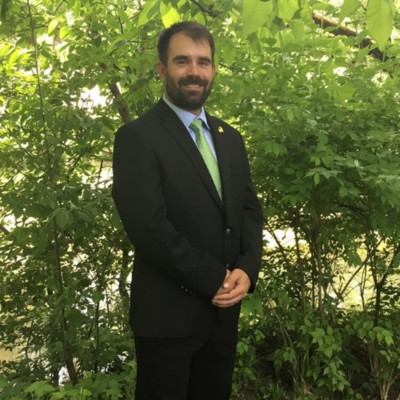
Jordan has been in the cybersecurity business for over 3 years and a six sigma black belt.
He is a former Marine with an extensive background in process management.
Jordan is an avid Bowhunter and is a participant on the podcast “The Bowhunters Heritage”.
In this episode of Security Confidential, Jordan discusses how his learnings and techniques as a bowhunter apply to cybersecurity.
About Us:
Dark Rhiino Security’s Security Confidential is a weekly Cybersecurity podcast where Host, Manoj Tandon, talks to Infosec and Cybersecurity professionals about the current issues going on in our industry. Guests are able to share their stories about how they began their journey into cybersecurity and connect with our audience. Listeners are able to tune in through Spotify, Apple Podcasts, Google Podcasts, Amazon Music, iHeartRadio, Youtube, LinkedIn, and more.
For inquiries, please email media@darkrhiinosecurity.com
Share and spread the word!
Original podcast listings
Archive source: Original website record. Original wording and artwork retained.