SECURITY CONFIDENTIAL
Security Confidential S3 E4 Nick York
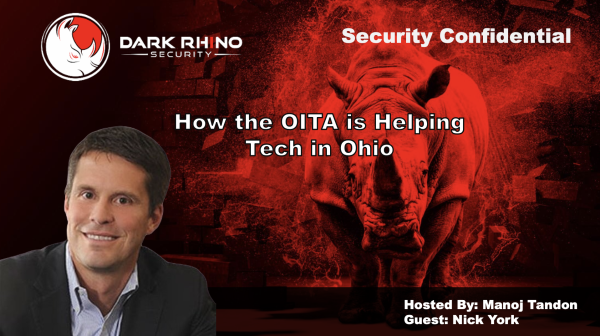
This week on Dark Rhiino Security’s Security Confidential podcast, Host Manoj Tandon welcomes Nick York. Nick the president of OITA joins Security Confidential in this episode and discusses the many activities OITA is involved with. In addition to being the president of OITA, Nick is an entrepreneur and an attorney with 20 years of practice experience and […]
Video
This week on Dark Rhiino Security’s Security Confidential podcast, Host Manoj Tandon welcomes Nick York. Nick the president of OITA joins Security Confidential in this episode and discusses the many activities OITA is involved with. In addition to being the president of OITA, Nick is an entrepreneur and an attorney with 20 years of practice experience and a strategic advisor to large and small companies, non-profits, and educational institutions. Nick is the co-founder of and serves as the CEO of the Transom Group.
How the OITA is Helping Tech in Ohio
Chapter Titles:
00:00 Introduction
01:37 What is the OITA
03:10 Environment for startups in Ohio
05:08 DeWine,Husted, and Ervan Rodgers Leadership in Technology
07:11 Innovate Ohio
12:27 Origins of the OITA and Its’ mission
15:09 Reforms in Procurement in the State of Ohio
20:44 Cybersecurity focus in the State of Ohio
23:36 Cybersecurity, protecting the infrastructure
28:02 Hot Potato complex in cybersecurity
31:41 2021 OITA policy and initiatives
37:03 OITA membership engagement
39:03 OITA events in 5G, Tech Talent, Tech Disruption, and Smart Mobility
Audio:
Spotify Embed: S3 E4 How the OITA is Helping Tech in Ohio
Important Links:
Transcript
Manoj Tandon: Hello everyone, and welcome to another episode of Dark Rhino’s Security Confidential. Today, we are honored to have Nick York join us. Nick York is a lawyer, entrepreneur, and strategic business advisor for businesses ranging from startups to Fortune 500 companies, universities, and national non-profit organizations. In addition to a successful legal career, Nick has been an owner, investor, and director of several companies, including his holding company, Kaiser Enterprises LLC, and as co-founder of Transom Group, a technology and industrial automation consultancy doing business in the US and Latin America. Nick’s 25-plus-year career has been centered around business, technology, and public policy, which led him to his current role as co-founder and president of the Ohio IT Association—Ohio’s premier statewide trade association serving the interests of tech and tech-enabled companies and leaders throughout the state. Thank you for joining us here.
Nick York: Yeah, we look forward to this conversation because as a small business in Ohio, that’s how we got introduced to you, and we’re fortunate enough to be a part of OITA. But I think the work that’s being done needs to be—the story needs to be told, and it might be helpful to a lot of other businesses. Yeah, no, I appreciate that. So the Ohio IT Association is an independent, non-profit, non-partisan statewide organization that’s really focused on Ohio’s technology-driven companies and industry professionals, operating at what I call the intersection of business, technology, and public policy. We focus on kind of five key objectives: industry promotion—getting out there and talking about what great things are happening; advocacy—which is government relations and advocating for certain public policies to help tech and tech-enabled companies advance; business-to-business engagement—getting companies together and connecting them in a networking type of thing; professional development—which again, whether it’s a group of CIOs or a group of CTOs, a group of software developers, whatever it might be, connecting them and trying to create platforms for them to connect not just in their particular region or their city, but around the state; and then finally, a critically important one is the ubiquitous talent attraction and development. While we don’t try to reinvent the wheel with a lot of other great tech associations or workforce development groups, we do try to highlight what Ohio is doing from a talent standpoint, ultimately to make it a stronger ecosystem and attract and retain more people here so that we can help advance the state as we go forward.
Manoj Tandon: We’re headquartered out of Dublin, Ohio, but Columbus and Dublin have become quite a—the Columbus region, I should say, has become quite a mecca for startup companies. There’s been a lot of them that have come up. We had Nick Potts on the show, who is the CEO of Gift Health. He’s been able to attract a lot of attention, both from his past ventures and his current ones. We’re seeing other companies like Updox just get acquired. Another startup operation, Bold Penguin, got acquired. So it seems—somehow when you think of Ohio, you don’t think “technology startups,” but do you?
Nick York: Yeah, I’ve seen that. Columbus is obviously a terrific example; there’s no doubt about that. But I see it throughout the state. One of the pleasures of what I get to do is I get to travel around the state a little bit and see these opportunities burgeoning up, whether it’s in the “Three Cs”—Cleveland, Columbus, or Cincinnati—or really in northwest Ohio in the Toledo area, or some of the even more rural areas, or down in southeast Ohio in Athens and Ohio University, and things that are coming out of those things. It’s really rewarding to get to see those types of young companies that are starting out, young entrepreneurs. I’m an old entrepreneur now, but young at heart. To see that—and that’s again a role that we’re trying to play as OITA: how can we help foster that? Whether that’s connecting people, whether that’s providing introductions for access to capital, or whether it’s just helping with good mentoring and trying to keep people from making the mistakes that many of us have made along our way to help them get to success a little bit quicker. It’s an exciting time for Ohio, and it’s an honor for me to get to travel around the state and do more of that.
Manoj Tandon: Now Nick, recently you had an event online with the state of Ohio where you had the CIO from the state join and discuss. Were there any insights regarding technology in Ohio and with the state that came out of that?
Nick York: Sure. Well, here’s what I would say. I think the DeWine-Husted administration—Governor DeWine and Lieutenant Governor Husted and their team on the technology side or the state CIO Ervan Rodgers, who you mentioned—they’ve done a really good job, I think, of trying to identify technology needs, looking at advancements, setting up organizations within the state government or sort of the public-private sector partnerships to really better understand what the state needs in terms of technology and how the state can play a role not only in advancing technology needs with state agencies, but also helping the private sector. So for instance, you’ve got Innovate Ohio, which is led by the Lieutenant Governor. They’re doing things from a user experience standpoint with state government agencies, but also looking at—they’ve got their Cyber Ohio initiative, looking at how do you help both public and private sector entities better deal with cybersecurity threats. You’ve got things around broadband access and the infrastructure that’s going to be needed as we continue to grow and trying to address the digital divide issues that are everywhere in the country. Ohio is the same, both in rural and urban areas. So I would give credit to the state in terms of thinking about what the challenges are and how the state can play a role. Obviously, there’s a lot to do, but it’s good to have leadership that recognizes the value of technology and the need to invest in that, and invest in the companies and the public policies that are needed to be successful.
Manoj Tandon: You mentioned Innovate Ohio. Is Innovate Ohio a program which is more about guidance, or does it also make funding available and make some policy changes that enable a much healthier technology environment?
Nick York: Yeah, I think so. So it started off—I believe that the impetus was how we were going to make technology more effective for the state agencies. And if you think about it, obviously there are—we interact with the state more than most people might think. If you think about the Bureau of Motor Vehicles, if you think about unemployment, if you think about Job and Family Services—for other folks in disadvantaged areas, maybe it’s Medicaid. So there’s a lot of things that the state touches on that we’re involved in where technology is playing a role. So the first thing that Innovate Ohio really set out to do is: how do we provide a better user experience within state government to provide those services to its citizens, so that it’s more efficient and effective? You’re ultimately providing those services in a more advanced way. One of the things that they’ve continued to do, though, in addition to that, is really think outside of just state government. How can the government play a role in helping to advance private sector advances in the use of technology? So the Innovate Ohio board, the advisory board, is made up of folks from the private sector and from the public sector—everything from big and small companies to universities, etc. It really has a mission, I think, long-term, of really trying to set Ohio apart from an innovation standpoint. What we do at OITA is try to foster a business environment or an environment overall for more technology use and adoption. I think Ohio is really leading the way with Innovate Ohio and some of the initiatives coming out of that program.
Manoj Tandon: Is there a particular agency in the state that you think might be ahead of the curve, if you will, in terms of adoption and dissemination of technology to the citizens?
Nick York: Yeah, you know, I wouldn’t single one out. I think that obviously with COVID—one of the things that we saw with COVID over this past year—is from a public health standpoint and the sort of immediacy that was required. And the ability for Ervan Rodgers as the state CIO to kind of marshal the forces that were necessary to have a coordinated effort to figure out how we were going to respond to this. Because obviously, there was a health issue at first, but then there were just the goods and services that needed to be provided in a new kind of remote or online way that we didn’t have to do in the past. So I would give them a lot of credit for thinking holistically about this and trying to integrate the various agencies into it. Obviously, from the public health standpoint, whether it was the contact tracing initiatives or some of those things, it was really leading the way over this past year. But I think what that did is it opened the eyes and opened what I’d call the opportunities. People think of that as a challenge or a problem, and I think of it as an opportunity to really improve. I would give credit to the state for being forward-thinking and really jumping in with both feet, so to speak, in terms of how we’re going to solve these problems.
Manoj Tandon: Now, outside of healthcare—that’s a great example. A couple of episodes back, we had Shanoa Moss on the show. Shanoa is in the healthcare IT business, and she actually mentioned that COVID has led to a tremendous amount of innovation on the part of some very large healthcare organizations in the state of Ohio, which was surprising to me because you don’t think “large” and “innovation” go together. I mean, that’s kind of an oxymoron. But she mentioned that, and from what you’re describing, it looks like the State of Ohio team here also put a great deal of focus on that in marshaling resources, and that may have been a catalyst.
Nick York: Yeah, for sure. Again, nobody would wish upon anyone the effects of COVID or having to go through what we’ve had to go through. But I do think the—if you want to call it the silver lining of it—was really to open the eyes to all of us in terms of where some deficiencies we might have and where opportunities exist to really advance. And the impetus really to advance that technology. A lot of times, especially at a state government level, everyone knows that government moves a little bit slower than business, and that’s by design and intentional, and that’s not a bad thing in many instances. But in situations like with COVID, where you had to have kind of a rapid response and there were a lot of different moving parts, I think what it did is it helped advance the use of technology in the state and will set a platform, or a foundation, for moving forward and hopefully to continue to advance that technology adoption.
Manoj Tandon: Now Nick, switching gears here a little bit to OITA itself. What’s the origins of the organization? What drove you from attorney to entrepreneur and industrial systems to start creating an association?
Nick York: Well, that’s a good question and it’s a long story, but I’ll try to make it short. I think what we realized a couple of years ago—and I had operated at what I call the intersection of business, technology, and public policy for most of my career, right? Whether it was my legal practice or doing some government-related work in that practice, and then obviously having a couple of technology businesses now. And there were a number of people, many of whom were in Columbus, and they were from large organizations. They realized—looked around the room during a couple of different incidents where there was a need for an association. You look in Columbus, and there’s an association for just about everything, right? I mean, people know the manufacturers, and the retailers, and the doctors, and the lawyers. But there’s also—there’s a group for the bakers and the candlestick makers, and the whole thing. But unbelievably, there was not one for the tech industry. There are a lot of great regional tech associations around the state, but there was not, until two years ago when we really put this into practice in earnest, a statewide association. So that origin really was—and as we’ve developed, really a member-led effort. There were a number of ultimately members of the OITA who were looking for that representation that a trade association, for lack of a better term, could provide to help with a number of these initiatives and public policy focus areas that they needed help with. We were able to do that. We marshaled a lot of good people from the business community—big and small companies, as I mentioned. We’ve got a terrific advisory board, which you serve on and know. It expanded beyond that, beyond just the businesses to universities, community colleges, economic development groups from around the state, and other tech associations. The thing we did not want to do is reinvent the wheel or step on the toes of all the good things that people were already doing, but really find a way that we could help be a platform to convene and connect and collaborate, as I use all the time, from a statewide perspective. So the origins were humble origins, really born out of need and necessity, and driven by the members. That’s how we continue to be driven today: by our members.
Manoj Tandon: Well, I hope one area that the members are pushing in—and I’ll just speak for Dark Rhino Security—is in procurement. I mean, we’ve banged our head against a wall, which is probably the best description in trying to do business with the state. It seems like an arduous task and, quite honestly, it seems like the deck is stacked against us. Every RFP that comes out seems like it’s pre-ordained to go to somebody, and it’s not us, I can tell you that. So it would be good if there’s such a great push, like you’re describing, at the state level, and the leadership of Governor DeWine recognizes that to give small businesses a chance—we are the engines of innovation—it would be nice to be able to showcase that in the state environment.
Nick York: Well, taking that out of Dark Rhino in particular—because I know you guys have a lot to offer and could be a good partner, there’s no doubt—but taking a step back and looking at it from a procurement process, it’s one of the things that as an organization we’re focused on. We have a procurement committee, which has been tasked with the role of coming up with recommendations that we can share with state leaders and help them to better understand, especially from the technology side. Manoj, I think part of the issue is that government is different than the private sector, and intentionally so. You want to have certain protections for transparency and all those kind of things in a public contract. That has its complexities and challenges for sure. The other thing from a procurement standpoint from the state—technology is advancing so quickly. If you look at sort of the Astro Teller graph and how quickly we are advancing as a society, government policies and programs really have been designed on a “one size fits all” basis in many instances. In other words, you’re going through the same procurement process as you used to to buy pencils and paper or engineering consulting services, but you’re applying it to technology. One of the things as an organization that we’ve tried to push is: sometimes you have to think a little bit differently. That “one size” does not fit all, and you have to get the state to operate at the speed of business. I think that with COVID and other things that have happened recently, that’s never been more clear. So one of the things that we look at from a procurement process is really trying to help the state think about ways that it can improve that process and be more responsive to companies large and small, and to try to find ways that you can be more adaptive and adoptive of new innovative approaches to providing technology. I would say that, again, working closely with the leadership at the state level—at both the executive branch as well as within the legislature—we have some receptive ears. It’s just a matter of putting some of that hard work in that goes into explaining where the challenges are and where the opportunities might be.
Manoj Tandon: See, that alone might be worth the price of admission to OITA. I think everyone who’s listening to this broadcast—if you’re in the state of Ohio and there are items like procurement, which is near and dear to us, but I’m sure you have your own—OITA would be a great mechanism to get a much broader voice at the state level than as an individual business and actually get some traction.
Nick York: I agree with you. I think that’s one of our main value propositions. Again, we’re not going in as an organization advocating for any one company; that wouldn’t be the right way to do it. What we are advocating for is streamlining processes, opening up the door, and being open to the potential for our members and other technology companies to have more of a chance to tell their story and to get their opportunities. No doubt we’re good at that. We have good, strong relationships. We’ve built that over many years—not just me, but many people who are on our team. We’ve become, in many ways, a trusted advisor, and we guard that trust jealously. We don’t come in and just sort of willy-nilly make demands and challenge approaches; we try to have an ongoing dialogue. What that does is it gives us an opportunity to be a stronger voice, ultimately on behalf of our members. But if you are a company that’s out there looking to engage with the state, looking to better understand the procurement process, we can certainly help with that. We’d encourage you to join and become part of what we’re doing and add your voice to that discussion.
Manoj Tandon: You mentioned that states—the way they’re procuring or the way they’re operating—moving them to operate at the speed of business is certainly a challenge and it’s a goal. But if we switch to cybersecurity, it’s moving even faster than that. So if we look at what’s happening in the private sector, at the government level, at the federal government level, and then at the state level, is there any kind of priority within the state of Ohio looking at cybersecurity? What areas could they address, because that’s changing on a second-by-second basis?
Nick York: That’s right. Well, there’s no doubt. I mean, you and I have talked about it before—whether it’s the Russia hack or SolarWinds—and really trying to understand what the bad guys are doing out there in terms of trying to focus on where’s the weakest link and attacking those weakest links in a supply chain. Obviously, the state does business with a lot of companies from around the state and in the world, literally. So I think one of the things that has happened—again, as a result of more recent events with, as I mentioned, sort of the SolarWinds stuff—is raising awareness. Last year, there were a lot of small or mid-sized municipalities or townships that were getting hit with ransomware, and things like that really brought it to the forefront. I do think there’s some leadership at the state level recognizing that. As I mentioned, Innovate Ohio and their Cyber Ohio initiative really aim to work not just for state government but also with companies, putting some public policy around recommendations, some “how-tos” or best practices. Again, it’s a great way to engage if you’re in that sector—to get involved with what we’re doing and use our megaphones, so to speak, to better tell that story. While I think there’s attention and importance placed on it, that is not a substitute for action and the comprehensive nature of what we need. Those are things that you guys are on the front lines of—really finding those ways to put words into action, to put insights into implementation, as we say at Transom. That is really where I think we are in the process. I think that if we’re not careful, we’re going to have some major issues. Ultimately, there’s no government that wants to have to respond to an attack where data’s been breached or privacy has been impeded.
Manoj Tandon: Data breaches and privacy are absolutely threatened and they’re of importance, but I think there’s something of even much greater importance, and that’s protecting the infrastructure of the state. Ted Koppel wrote a book called Lights Out several years ago, and he talks about how the power grid is very vulnerable, and he’s absolutely right. If you get a chance to read it, it’s an easy read—it’s a light-hearted read—but he makes some very good points. At the federal level, this is—with all the partisanship going on, I don’t know if we’re going to see movement in that arena. But it would be nice to see states start looking at their infrastructures and looking at how we protect that from a cyber perspective, because they could probably do much more locally than what a federal initiative, if it ever comes about, would be.
Nick York: Yeah, I agree with you. I’m certainly not the cybersecurity expert that you are, or that many of your listeners may be, but I can certainly see the tsunami of potential damage that’s coming. I feel like we’re out in front of a wave right now; that wave is building. You see it both from what you call the business espionage factor, or governmental—government to government—or just people who just want to wreak a little havoc. That wave is building behind us, and we’re out front of it to some extent. We talked a little bit about Transom and sort of the industrial automation. We do a lot of Internet of Things and things like that, and just all those different touchpoints which now have vulnerability. If you think about it from the state perspective, there are a lot of different touchpoints where people interact with the state. Whether that’s infrastructure or their network, etc., I think the challenge for any state is: there’s budgetary issues, there’s constraints. Clearly COVID has an impact on the budget. How are we going to do that, and maybe thinking about creative solutions to solving some of those problems? Again, whether it’s you guys at Dark Rhino or your broader audience or others out there, I would encourage you to get involved with what we’re doing so we can start to address some of these things and bring these creative solutions. A lot of times, you don’t know what you don’t know, and that’s true whether you’re the Governor, or Lieutenant Governor, or the state CIO. They’ve been very open and receptive to our message and are willing to be involved. So, there’s a lot more to do, there’s no doubt, and we need bright minds and a lot of rolling up our sleeves and getting to work on it.
Manoj Tandon: Transom works in industrial control systems. Have you seen a focus on cybersecurity with ICSs?
Nick York: Yes. And again, I’m the entrepreneur, right? In terms of the technical stuff, we’ve got a great team that we’re working with. But a lot of the folks that we work with are large manufacturing operations—the large car manufacturers or large industrial products manufacturers. As we’re continuing to advance their smart manufacturing capabilities, the threats and the potential for havoc continue to grow. There has been a continued importance around that. Much of what we do—we ultimately end up partnering a lot of times with more advanced cybersecurity firms to be co-partners in some of our initiatives, because we’ve got a good team, but we don’t have the depth that many folks like yourself would have in terms of that. So we do see that it’s definitely a point of interest and a point of concern. It certainly is for us, because as the consultants who are coming in and helping to implement some of these changes, the last thing we want to do is be looked at and have them say, “Why didn’t you think of that for us? Why didn’t you talk to us about that? Why didn’t you bring the right team behind you to raise this?” So we feel an obligation to raise it even if it’s not being raised by our customers or clients.
Manoj Tandon: There is a bit of a “hot potato” complex in cybersecurity when it comes to ICSs, or at the state level, or the federal government level. Everyone has been like, “Yeah, we know this is a problem,” and they toss it to the next guy. The problem with that—I mean, there are real-world implications. I don’t know if you remember the TRISIS attack that happened at Saudi Aramco; it shut down that refinery. That was a direct modification of their safety control system in the refinery. Thankfully, the guys who did it didn’t know much about how a refinery operates, so they shut it down, which had an impact on global oil prices, but they didn’t cause anybody to get hurt. No one was hurt in the process. You look at the Russian and Ukrainian issue: the Russians cyber-hacked the Ukrainian grid and were able to shut power off in the country. We don’t want to be in the United States in that situation where—the greedy guys who do ransomware, worst-case you’re going to pay them off, and that’s just greed. But people who are looking to do genuine harm to a population—that’s a very different defense mindset. Getting folks out of that “hot potato” mentality… someone’s got to address it.
Nick York: Well, I think that’s where you need a coordinated effort. It’s not like you can just put that on the state, because some of the things you’re talking about—whether it’s the infrastructure, the grid, the electric grid, or things like that—there’s a state aspect to that, there’s a federal aspect to it, and there’s a company aspect to that, as you well know. I think the coordinated effort from what you consider the cybersecurity side and the law enforcement side—all of those things—are something that, from a greater public policy standpoint, are important to the state from a protection standpoint. We can’t be throwing the hot potato around. No doubt we have to stop; we all have to sit in our musical chairs. Everybody has to have a chair and a seat at that table, and we’ve got to try to solve that. It’s easier said than done and, unfortunately, a lot of times it takes a crisis to create enough awareness or enough impetus to get it done. I hate to keep going back to COVID, but just the fact that so much is being done online and so much is being done differently—you need protections for it, even if it’s just from a data privacy protection standpoint. That is where the state’s involved. If you think about healthcare and some of the records, and all the information that you provide—whether it’s your taxes or your health information—to state agencies, that needs to be protected. So I think that the infrastructure issue is a critical one. It’s a bigger one than any one state can address. And then some of the other stuff at a more granular level to individuals is equally important, at least from the state perspective.
Manoj Tandon: So Nick, let me ask you this: switching gears again a little bit for 2021, where do you see the OITA policy initiatives going? Are there some hot areas?
Nick York: I appreciate that. As I said maybe at the beginning, OITA is a relatively young organization. We essentially got started a couple of years ago. We had our first big launch in November of 2019 in terms of an event, and then we got into 2020. We had a number of things planned, and then COVID threw a wrench into all of our lives. As an organization which is really built around bringing people together, we had to adjust like everyone did. We did that around several policy areas and our virtual event series, and we’re going to continue to do that. But things like broadband infrastructure—that’s critical because that addresses the digital divide component. There’s a whole “haves and have-nots” issue around those issues as well.
Manoj Tandon: Is there really that big a divide? You think now, you can walk down the street in Columbus and pick up public Wi-Fi from somebody.
Nick York: If you’re walking downtown in Columbus, you’re probably okay. If you’re in certain suburban areas, you might be in a spot that just doesn’t have it. Representative Carfagna, who has been part of one of our virtual event series, talks about it: he lives in a nice neighborhood in a suburb of the Columbus area, and there are spots in his neighborhood where certain houses don’t have the same level of connectivity that other houses down the street do. And then if you’re talking about some of the rural areas or the urban areas, you definitely have pockets—large pockets—where there just really is not the bandwidth and the connectivity. Why that’s so important—besides just the fact that we want to have faster internet speeds so we can download and stream Netflix—is as we look to do more tele-education, more telehealth, and more online and remote working. If we don’t have that infrastructure in place, that eliminates literally millions of people in the state of Ohio from the ability to effectively compete or take advantage of the reduced costs that are associated with that technology. While if you live in the “Big Three”—the Three Cs: Cleveland, Columbus, and Cincinnati—and you’re downtown where there’s a lot of business operations, sure, you’re fine. If you live in the suburbs of many communities where I live, sure, I’m fine. There’s not that same level of access in many urban areas and many rural areas throughout the state, and that’s an issue that we need to address.
Manoj Tandon: I learned something new today.
Nick York: In terms of other issues, we’ve got everything from events talking about 5G and what that means. We’re talking about areas around education and workforce development in our tech talent sector. We’ve got things around cybersecurity—we’ve talked about that a fair amount today—but we’ve got initiatives there where we’re working with both the executive branch and the legislative branch on issues with respect to that. Going forward, we’re going to stay involved in the broad cross-section that we’re already involved in. As I mentioned, we’re member-driven, so the things that are most important to our members ultimately bubble up to the top and give us a reason to engage. We’ll continue to provide a number of virtual events; we’ll do some educational forums when we’re able to. We’ll start to get back in person and connect people. We’re focused on procurement reform, and we’ve got a set of recommendations that we’ve put forward to the state on that. We’re going to continue to push there. But what I would say, Manoj, is the thing that we’re trying to do is not just be an organization that talks about or reports on the needs of the state or the needs of our members, but to really get in there, roll up our sleeves, get our hands a little bit dirty, take the initiative, put a stake in the ground, and get something done. Because that’s really the success. It’s not really about talking about what we do. I hope to look back many years from now and be able to point to the things we accomplished—not that we built a big organization, but that we accomplished things with that big organization. So that’s what I’m looking for 2021 to be: really a breakout year for OITA. Our goal is to drive membership, get more people involved and into the discussion, and really start to put a stake in the ground on some of these important issues across the spectrum of technology to allow companies to grow and thrive here.
Manoj Tandon: You’ve taken up a huge cause, Nick. That’s a big challenge. And I think OITA’s success is going to rest in the membership getting engaged. I mean, you’ve put together a great platform, and you have the contacts and the ear of the state. We need as individual members to engage heavily and push on those topics. That’s the only way. I think a lot of people think you join an association and then the association does all the work.
Nick York: I don’t believe that’s the best way. That’s certainly not the model that I wanted to follow. I’ve been involved in a lot of organizations and served on a lot of boards—everything from a major university to small non-profit boards. But in starting one and thinking about what this organization can and should be, it really was about being member-driven. It’s not going to be Nick York who gets all that stuff done; it’s going to be all of us collectively working together. If I can provide the platform, as you said, and the connectivity, great. That’s the role that we can play. We’re not looking to reinvent the wheel. We need member participation. We want your good ideas, we want your insights, and we want you to be successful in growing your organization and your business—whatever it is that you’re involved in. Whatever your passion, we’re going to help facilitate that and get it done. That’s how we’ll be successful: as a collective and doing it together, not by a small group of staff members at an association.
Manoj Tandon: I couldn’t agree with you more. Hopefully, we’ll have a lot more folks joining us this year. Now Nick, I know we’re coming up on the hour here. Before we part ways, I wanted to, of course, thank you for doing this. I think it’s very important. But also, do you have any events coming up or anything you’d like to plug?
Nick York: Yeah, we’re in the planning process right now for a number of events. We’re working on a 5G event, a tech talent event, and a tech disruption event—which is kind of a broad look at innovation and technology in both the public and private sector. We’re looking at events around smart mobility, and talking with various state and local governments and the private sector on smart mobility. We don’t have something planned right now that I can give you the date on, but that’s actually a good opportunity for your listeners. If you’ve got interest in the organization and in some of the events that I mentioned, we’re in the formative stages of those, and we’ll be rolling that out for the first quarter and then a number of events on a monthly or bi-monthly basis going forward. If there’s interest, I would encourage all of your listeners to get involved with what we’re doing, share your ideas, and help us craft what’s important to you, and find ways to work together here.
Manoj Tandon: Absolutely. We will link up in the show notes the website for OITA and their LinkedIn, and we’ll link back to you as well—your personal profile and email. Hopefully Rose won’t get too mad with getting—we’ll get it done. We’ll get this information out there, and we’ll make sure that it’s all in the show notes so that folks, if you’re listening, you’ll just be able to click on the link and be able to get to the OITA. Nick, thank you so much for joining us this afternoon. We all greatly appreciate it.
Nick York: Thanks for having us. It was my pleasure, and I look forward—my door is open, my phone rings, and my email is available. So for those out there who are interested, when you get that information, if you’ve got questions, reach out. Let’s work together. I think we can accomplish great things if we do it together.
Manoj Tandon: Thank you. Absolutely. Thank you, my friend. We’ll talk to you soon.
Learn more about Nick on his LinkedIn
To learn more about The OITA please visit their website
Check out the other episodes in Season 3:
Ep. 0 Tyler Smith – Cyber Basics: Training the End-User
Ep. 1 Manoj Tandon – Was it worth it? Lessons Learned
Ep. 2 Chenoa Moss – Healthcare IT: Innovation at the Speed of Life
Ep. 3 Karla Reffold – Do Women make more Money in Cyber?
Ep. 4 Nick York – How the OITA is helping Tech in Ohio
Ep. 5 Dr. Calvin Nobles – How Human Factors Can Impact Cybersecurity
Ep. 6 Karl Sharman – How to Hire and Retain Cybersecurity Personnel
Ep. 7 James Azar – How Secure is Your Organization?
Ep. 8 Jordan Graham – Business Lessons from a Bowhunter
Ep. 9 Chris Auger – Why Microsoft 365 is difficult
Ep. 10 Jeff Manhardt – The Power of Why
About Nick York

Nick York has served as Vice-Chair of the University of Akron Board of Trustees, focused extensively on Strategic Planning and Student Success initiatives. He has been a champion of entrepreneurship on the national level as a Board Member of the National Small Business Association (NSBA) in Washington, DC, and as Vice-Chair of the Council of Smaller Enterprises (COSE) the largest small business member organizations in the country.
Nick is also a Co-founder of the Mindful Nation Foundation (MNF). Inspired by the book, A Mindful Nation, Nick helped launch the organization to bring together the best in cognitive science, community leadership, and proven techniques to develop programs to improve the lives of Veterans, Children, Teachers, Healthcare providers, and Leaders.
About Us:
Dark Rhiino Security’s Security Confidential is a weekly Cybersecurity podcast where Host, Manoj Tandon, talks to Infosec and Cybersecurity professionals about the current issues going on in our industry. Guests are able to share their stories about how they began their journey into cybersecurity and connect with our audience. Listeners are able to tune in through Spotify, Apple Podcasts, Google Podcasts, Amazon Music, iHeartRadio, Youtube, LinkedIn, and more.
For inquiries, please email media@darkrhiinosecurity.com
Share and spread the word!
Original podcast listings
Archive source: Original website record. Original wording and artwork retained.