SECURITY CONFIDENTIAL
Security Confidential S20 E0 Dale Meredith Jr
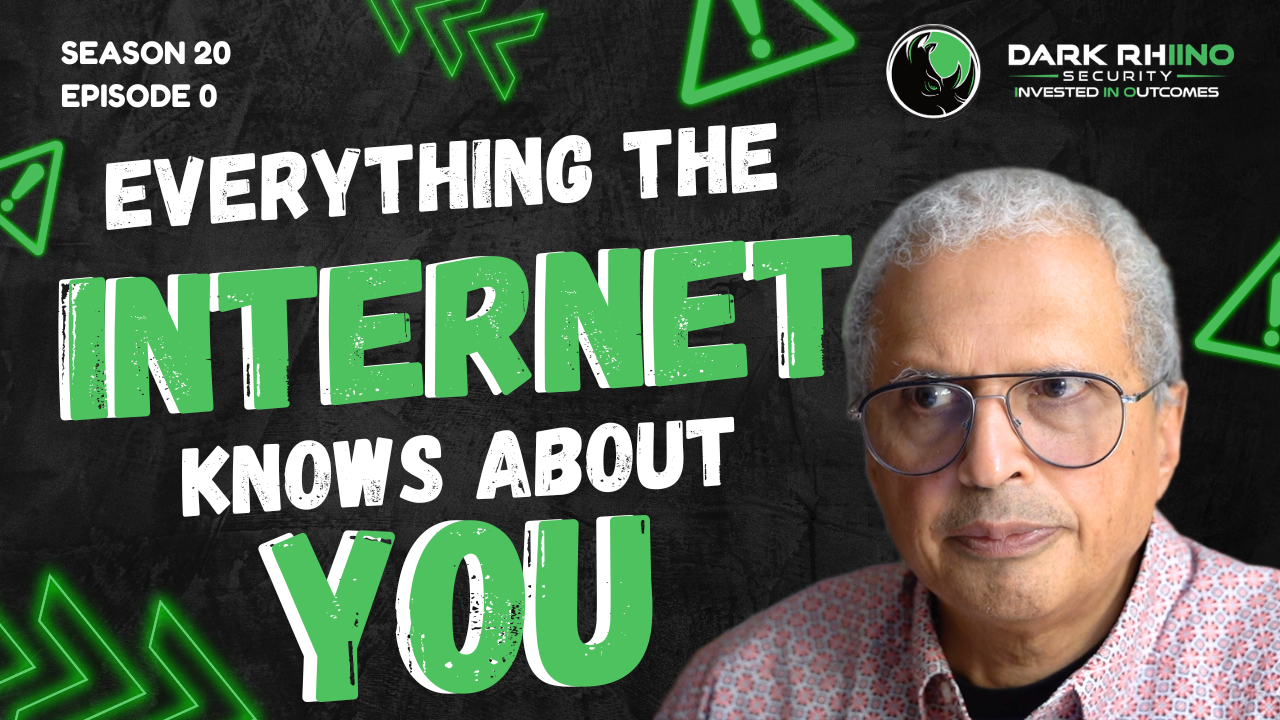
This week on Dark Rhiino Security’s Security Confidential podcast, Host Manoj Tandon welcomes Dale Meredith Jr. Dale is a cybersecurity educator, ethical hacker, author, and international speaker with more than 25 years of experience. Dale has trained everyone from Fortune 500 companies to the Department of Homeland Security and military organizations, while helping thousands of professionals better understand […]
Video
This week on Dark Rhiino Security’s Security Confidential podcast, Host Manoj Tandon welcomes Dale Meredith Jr. Dale is a cybersecurity educator, ethical hacker, author, and international speaker with more than 25 years of experience. Dale has trained everyone from Fortune 500 companies to the Department of Homeland Security and military organizations, while helping thousands of professionals better understand cybersecurity through his books, courses, and conference presentations.
Everything the Internet Knows About You | Security Confidential
Chapter Titles:
00:00 Intro
03:10 The evolution of internet infrastructure and early hacking experiences
08:56 Biggest flaws in TCP/IP networking today
14:39 OSINT and the explosion of data collection
22:29 Social media, online activity, and digital footprints
30:07 AI’s impact on jobs, security, and ethical considerations
35:46 The future of AI, regulation, and cybersecurity challenges
Audio:
Spotify Embed: S20 E0 Everything the Internet Knows About You
Important Links
Transcript
Manoj Tandon: Hello everyone, this is your host, Manoj Tandon. Welcome to another episode of Dark Rhiino Security’s Security Confidential. Today, we have another great guest for you. I have to remind you, please hit the like and subscribe button. It helps us out, shows us a little bit of love, and allows us to keep bringing you this great content. It also makes us feel good when you click those buttons. Without further delay, I want to introduce you to someone many of you may already know: Dale Meredith Jr. Dale is a cybersecurity educator, ethical hacker, author, and international speaker. He has been around the block, with 25 years in this business. He has trained everyone from Fortune 500 companies to Homeland Security and military organizations, and he has helped many professionals understand cybersecurity better through his books, courses, and conference presentations. Dale, welcome to the show. We really appreciate you being here, and thank you for joining us.
Dale Meredith Jr.: Man, thank you so much. I am excited that you reached out. I am always excited to get a message out about security because of how important it is in our lives. I really appreciate the opportunity to be here.
Manoj Tandon: We want to download as much information as we can from you over the next 45 minutes or so. With that, we want to start with a little about your background. Were you always involved in cybersecurity or computer science from the beginning, or how did you land in this world?
Dale Meredith Jr.: Computers have always interested me. Back when I was in high school, I was a member of the computer club, but I was not the nerd. This was back in the Apple II days. I joined the computer club because I liked playing games, and I was interested in how computers worked. As I got older, I found myself becoming a Microsoft trainer. I have been doing that since the Windows NT 4.0 days—and even Windows 3.11.
Manoj Tandon: Whoa, that was a long time ago.
Dale Meredith Jr.: As a matter of fact, you know how Bill Gates supposedly once said we would never need more than 640K of memory? I have my own famous quote. I was at a convention where Microsoft was showing off Windows for Workgroups. I asked what it did compared with Windows 3.1, and they told me about its ability to share information. I said, “Why would you want to do that?” It did not make sense to me at the time. Obviously, I eventually drank the Kool-Aid, and now I believe in networking. I found myself traveling around the United States teaching Microsoft products—not Word or Excel, but the server line, SharePoint, Exchange, and many other platforms. The only one I did not teach was SQL. While doing that, I started working for a training center in Salt Lake City. They were bringing in a subcontractor to teach the Certified Ethical Hacker course, and they asked whether I wanted to sit through the class so I could teach it myself. Since I was their employee, they would not have to continue paying the higher price for the contractor. I said yes, jumped into the class, and realized that some of my background naturally carried over. I did not realize I was already a hacker before taking that course. Whenever I attended a Microsoft train-the-trainer course or something similar, I would sit at the back of the classroom and try to get into the instructor’s computer. For any law-enforcement people listening, I did not do that—it was a friend of mine. I was trying to get access to their information, slides, notes, and other materials. I need to backtrack a little, though. Before I went to that training center, 9/11 happened while I was working for another training company. As we all know, training budgets are among the first things cut during an economic downturn. Even though I was a senior instructor specializing in TCP/IP and Exchange, I found myself unemployed two days before Christmas.
Manoj Tandon: Wow.
Dale Meredith Jr.: I lived in a rural community at the time and decided that DSL was not fast enough, so I started a wireless internet service provider and got involved with the infrastructure. It was really cool. One of my neighbors was Mark Burnett, a white-hat security professional at Microsoft. He told me, “Dale, if you give me free internet, I will show you everything I can about security and help you lock down this network.” That was one of the best things I ever did because I began learning so much. We launched our ISP service in Syracuse, Utah. I thought, “Who is ever going to pay attention to me?”
Manoj Tandon: Wow. Was this all being run through one DSL line?
Dale Meredith Jr.: We brought in two T1 lines.
Manoj Tandon: Okay.
Dale Meredith Jr.: We had a three-megabit download pipeline.
Manoj Tandon: A T1 was a big deal. That was an expensive proposition back then, but go ahead.
Dale Meredith Jr.: It definitely was. This was back when AOL was still around and people were still paying to use those screeching modems on their desktops. We came in and said, “For $19, you can get 128K.”
Manoj Tandon: That was double the speed of the fastest modem at the time.
Dale Meredith Jr.: Absolutely. We became the fastest-growing ISP in Utah during that period. I eventually sold the company, but I learned a tremendous amount. When we first turned on our router, we began receiving denial-of-service attacks within seconds. That was when I discovered that I was simply a number on the internet. My router was an IP address, and it did not matter where I was physically located. To make a long story short, I sold the company, went to work for the training center, and began teaching Certified Ethical Hacker courses alongside my Microsoft courses. I fell in love with it. I started working with Homeland Security, got involved with physical penetration testing—which remains one of my favorite things to do—and everything took off from there. It is interesting that, even at a young age and without realizing I was a hacker, I was already hacking. I would modify games to get more lives and use old ASCII programs to change my attributes.
Manoj Tandon: Were you ever able to completely decompile one?
Dale Meredith Jr.: No. That is one thing I should say about myself when it comes to security. As of recently, thanks to Manus, I know Python—although really it is because of AI.
Manoj Tandon: There you go. I am an expert. I have written a lot of Python code, and I could not tell you the first thing about the language’s syntax.
Dale Meredith Jr.: That is the same with me. When it comes to cybersecurity, I can scan a piece of code and say, “This is wrong,” but I could not necessarily explain why it is wrong or how the programmer arrived at it. I do not simply look at code and immediately identify the exact problem.
Manoj Tandon: Since you started in the Apple II days, did you ever hack an AppleTalk network?
Dale Meredith Jr.: No. I did not have access to one, or at least I could not afford access. My first computer was an Apple IIc.
Manoj Tandon: Okay.
Dale Meredith Jr.: I never got into AppleTalk. I wish I had experimented with it more.
Manoj Tandon: Since you have known TCP/IP networking for ages, what is the biggest flaw that still plagues it today?
Dale Meredith Jr.: I look at security a little differently. When I think about TCP/IP, my security mindset immediately comes on, and the biggest issue is that you are traceable. It is not necessarily a technical flaw. Networking protocols will always have certain weaknesses, but I think about how I am being tracked. My computer, phone, and other devices are constantly reporting information. ISPs can easily determine your general location. If I travel to Las Vegas and connect through a 5G network, I receive an IP address that identifies me as being in Las Vegas. Some people do not care about that. I am one of those “black helicopter” people who worries about the what-ifs. To me, that is one of the biggest flaws. You can use VPNs, and some people will mention HTTPS, although that provides security more at the website level. I use VPNs whenever I travel. I went to Europe last year for a speaking engagement, and I used a VPN everywhere I went to protect myself. It is not because I think I am in a Jason Bourne movie and someone is pursuing me. I simply believe in personal privacy. It is one of the last things we have as individuals, but that is another discussion.
Manoj Tandon: Do we really have personal privacy when we go online? If someone genuinely wants to track you and has enough resources, it can be done.
Dale Meredith Jr.: Exactly, and that is why OSINT has exploded. Open-source intelligence was not a term we regularly used a long time ago. Now it is something we discuss almost every day. I recently watched a documentary that was amazing. Have you heard of surveillance pricing?
Manoj Tandon: No. Please tell us about it.
Dale Meredith Jr.: You and I could be standing in front of the same hotel, requesting an Uber to the same airport at the same time, and I could be charged more than you because of my profile.
Manoj Tandon: I would normally call that dynamic pricing, but yes, some organizations do that.
Dale Meredith Jr.: These data brokers create a catch-22 for me because I do not necessarily like the government becoming involved in everything, but this is one of the areas where I wish it would intervene. It is getting bad. Even with DoorDash, you might pay less or more than I do for the exact same order placed at the exact same time. It is based on all the data points being collected by your phone, including your location. If data brokers determine that you are expecting a child because you suddenly begin shopping for a crib on Amazon or researching baby products online, they may increase the price of diapers because they know it is something you will need. It is the ultimate form of OSINT because they have gathered so much data. While doing research, I found a claim that Kroger may have up to 62 pages of data on each person who shops there. I would have to find the exact source before you quote me, but that amount of data is insane.
Manoj Tandon: You could probably build at least a partial psychological profile from that. You would know what the person eats, what they buy, when they shop, and patterns relating to their lifestyle.
Dale Meredith Jr.: It goes beyond what the data brokers themselves collect. I shop at Walmart because, in my area, who does not? I use the app to prepare orders for pickup. Think about the implications. They know what I eat and what I like. If I repeatedly buy Diet Coke, perhaps the price of Diet Coke could be increased when I place an online order. The loyalty aspects of retail programs are not always loyalty in a positive sense. They may offer good features, but they are also collecting data. Some of that data gets absorbed by brokers and sold. Your information is being sold, including where you have traveled, where you spend most of your money, and your income-related activity online. It is crazy. This is an area where I believe the government should become involved because most viewers or listeners may not fully understand that this information is being collected. I think we have a right to know what is being gathered.
Manoj Tandon: If you are using an app to place orders, showing your membership card at checkout, or participating in a frequent-flyer program, I would assume that data is openly available. I would not even expect it to be especially secure anymore.
Dale Meredith Jr.: It is similar to social media. When Facebook first appeared, I began listing the movies, books, and music I liked. Then it dawned on me what I was doing: I was building a profile of myself. I went back and removed that information, or at least that type of information, from social media. The upside is that you receive advertisements about things you like. The downside is wondering where that information goes and what else is collected. That is the concern for me. There is information moving around openly, so what else is out there that we do not know about or think about in our everyday lives that affects us financially and economically?
Manoj Tandon: It has many implications. What does a background check entail anymore? It used to mean running a criminal-record check. Now that is only one part of the picture. If you genuinely want to understand a person, you can scan their social media. If you hire the right company, it could probably tell you what the person likes to eat, how they function, and which groups they belong to. After our generation, everyone moved completely online. People started posting everything on Instagram, Facebook, TikTok, and other platforms. All of that information could be considered fair game. If you are applying for a job or loan, starting a business, or trying to convince venture capitalists to finance you, it would be easy to conduct a very deep background investigation and learn far more about someone than they ever imagined.
Dale Meredith Jr.: I have mixed feelings about that. My wife conducts leadership courses and speaking engagements, and she previously worked in human resources. They performed background checks, and as you said, those checks used to focus mainly on criminal records. Now they involve almost everything. A large part of me believes that what I do and say on Facebook should have nothing to do with my work or whether a company hires me, unless there is a proven pattern showing that it could jeopardize the company. I have seen situations where people were fired after being hired because a company found a post they made five years earlier. Who is to say that person has not changed? Do we now need two personas—one public and one private? I do not even know how you would keep the private one hidden. You could create separate social-media accounts, but then you would simply be hiding things.
Manoj Tandon: You could avoid posting your photograph, but you would essentially have to construct a completely separate life.
Dale Meredith Jr.: Exactly.
Manoj Tandon: That is why I think it lends itself to abuse. Passing laws against it may not change much because people are people. Human nature is what it is. Someone will say, “You said that two years ago, and you cannot unsay it.”
Dale Meredith Jr.: Right.
Manoj Tandon: Do I know whether you have changed? Maybe you have. Perhaps you said something controversial or wrong and later received help for whatever condition contributed to it. But then you should not have to open your therapy records and everything else. Where does it end? Big Brother could go very deep. The smartest thing to do is simply not post these things online.
Dale Meredith Jr.: That is probably the best answer: do not become so involved in social media. One of my fears concerns my 18- or 19-year-old son. For his generation, social media is part of life. I tell him, “Dude, if you post it, it is there forever.” As I get older, I hope I am getting smarter—until I eventually become old enough to start getting dumber. When COVID first appeared, we did not initially think it would become as serious as it did. It was simply the coronavirus. I posted an advertisement from Corona beer on Twitter that said something like, “The Corona team has arrived.” It was a lighthearted joke because we did not understand the situation at the time. Could that be taken out of context 15, 10, or even six years later? Absolutely. I like your suggestion, and it is one I follow more closely now. I speak with people who post daily about their personal lives. We should not be doing that. You can post your thoughts about a situation, but I would be very cautious about posting personal information. Photographs particularly concern me. People post pictures without realizing what appears in the background—perhaps their street address, the address of their house, or information involving their children. We need to be extremely careful because it can lead in several dangerous directions. AI can now be used for virtual ransom attempts. Attackers know that you have a child, so they try to convince you that they kidnapped your child. They can gather information about your children, parents, grandparents, or other family members. There have been serious cases involving AI combined with OSINT.
Manoj Tandon: I know someone who was a victim of that, and the scheme worked. The person lived here, while his parents lived in India. The attackers gathered all kinds of information and told the parents, “If you do not transfer money, we are going to kill your son.” These were people over 80 years old. They came from a completely different generation, and their context for such conversations was very different from yours or mine, or from what our children’s response might be. Our children might say, “Go away and call somebody else.” The parents ended up paying and lost their entire life savings. There was no way to recover it because they willingly transferred the money. For anyone listening, what Dale is describing is not a joke. It can happen, and the mimicry has become so convincing that attackers can impersonate someone’s voice.
Dale Meredith Jr.: Here is an old-school tip for anyone wondering how to avoid this: create a family phrase. I have a phrase that my children know. If I receive a call saying, “Dad, help me. I am in jail,” the first thing I ask is, “What is the family phrase?” It has nothing to do with Batman. It is all Superman—no, I am kidding. It is simply a phrase only they know. It is not something they post online. If the caller does not know it, I can be reasonably confident it is not them.
Manoj Tandon: That is a great suggestion. What else should we do to limit the OSINT available about us? You are an expert in this area. If you go on vacation and post photographs, you reveal where you went, where you stayed, whom you met, and what you did. From that, I can gather demographic information, financial data, and even psychological insights because you clearly enjoy showing people what you are doing. I can see what you are wearing, which brands you like, and what you dislike.
Dale Meredith Jr.: Exactly—the brands you like.
Manoj Tandon: I can combine that with stolen passwords and determine whether any of those personality traits influence how you construct passwords. We can go down a very deep rabbit hole. I would guess that more than 60% of the time, someone could probably determine the passwords people use on their important accounts.
Dale Meredith Jr.: Thankfully, I use a password manager, so I do not know any of my passwords. That is one thing people can do to protect themselves. I know one password—the master password for LastPass, which is the manager I use. We are also seeing an evolution toward passkeys, which is fantastic. You can use a fingerprint, your face, or a trusted device to verify your identity. Two-factor authentication is also great. One of the biggest things you can do, although it may not be popular, is limit what you make available online. Much OSINT information comes from social-media platforms. My Facebook account includes only people I genuinely know. I receive invitations all the time from people who may have read my book or watched one of my courses and want to become friends. I ignore those requests. My account is for family and friends only. That does not eliminate all risk because my friends and relatives may not be as secure as I am. Someone could compromise their account and pivot into mine because their account has permission to view my information. Society has two major tendencies. First, we constantly prioritize convenience. Convenience is always the overriding force. Consider your phone. When you switch off Wi-Fi, you do not always fully turn it off.
Manoj Tandon: It is still broadcasting.
Dale Meredith Jr.: Exactly. The reason is convenience. Imagine connecting to someone’s Wi-Fi for the first time. It may take 15 or 20 seconds. If you turned off Wi-Fi while leaving your house and had to wait 15 or 20 seconds to reconnect every time you returned, you would think your phone was terrible. Devices continue listening for or broadcasting information related to SSIDs in the background so that, when you switch Wi-Fi back on, the device connects immediately. I have demonstrated this several times at conferences. During one demonstration, some gentlemen in black suits and dark sunglasses approached me—actually, they were casually dressed Gen Z or Gen X people—and asked, “How did you do that? You displayed our phones on your screen. These phones belong to our government agency, and they were turned off.” I explained that they were not completely off. We had an entire discussion about it. There are ways to address the issue, but those methods are generally unpopular because they reduce convenience.
Manoj Tandon: How can you fix it? On an iPhone, you cannot remove the battery. With older phones, you could pull out the battery, discharge the capacitors, and know the device was completely dead. With an iPhone, even when you turn it off, it may still broadcast its location.
Dale Meredith Jr.: The solution is to use a specialized security phone. It is not popular because those phones are extremely locked down. They do not have an Apple App Store or Google Play Store, even when they run Android. Many cybersecurity professionals use devices like that. I cannot remember the exact name of one—it is called Black something—but they are highly restricted. Think about what we store on our phones.
Manoj Tandon: Everything. Your entire life is on it.
Dale Meredith Jr.: I have children who do not own laptops or desktops because they do everything on their phones.
Manoj Tandon: It is a complete computer.
Dale Meredith Jr.: Exactly. We do not like losing convenient access to services such as Google Maps, but do not think Google Maps is not tracking you. It is. The most secure solution is not always the most popular or convenient one. It depends on how secure you want to be and what you are willing to tolerate. I will give you an example. I have a fear of flying. I have gotten better over the years, but takeoffs and landings still bother me, especially in Denver. Denver seems windy all the time. I have accepted that I have a greater chance of dying in a car crash on the way to the airport than in an airplane crash. That helps me. The same reasoning applies to why Dale Meredith, the cybersecurity guy, owns a mobile phone. I accept that I am giving up certain things, but I try to control the risks as much as possible. If I looked at my 19-year-old son’s phone right now, I would probably have a heart attack. The same would happen if I saw his passwords. He refuses to use the password manager I gave him. I tell him, “Dude, you are killing me.”
Manoj Tandon: Someone could make the counterargument that if you are driving through Death Valley, your car breaks down, and there is no cellular coverage, rescuers could still potentially locate a ping from your phone. Newer iPhones also have satellite communication capabilities. Those are edge cases, though. The broader point is that you do not really have privacy. The same applies if you use a wearable device such as an Apple Watch, Android watch, Oura Ring, or something similar.
Dale Meredith Jr.: I am waiting for wearable companies to partner with insurance companies. It may already be happening. Insurance companies would want that data.
Manoj Tandon: Car companies are already doing it. If you sign up for GM’s service—whatever they call it—
Dale Meredith Jr.: OnStar.
Manoj Tandon: Exactly. They were caught selling customer data.
Dale Meredith Jr.: I simply want to know where my share of the revenue is. Maybe I would feel better.
Manoj Tandon: They may be reporting, “This person speeds all the time.”
Dale Meredith Jr.: My wife has a Tesla with the self-driving feature. I am becoming somewhat comfortable with it. We have avoided three deer running into the road because the Tesla reacted and stopped in time. I thought, “I probably would have hit that.” At the same time, internally I am thinking about how much information Tesla is collecting about my driving habits. Tesla also sells insurance, and the monthly premium can change based on driving patterns.
Manoj Tandon: What happens if an attacker takes over the car and says, “Dale, you are not turning left here”?
Dale Meredith Jr.: I have had the automated driving system turn right when it was supposed to turn left, and I quickly took control to correct it. One positive aspect of people publicly sharing information about vulnerabilities—something I enjoy about cybersecurity conferences—is that companies such as Tesla or Microsoft can then fix the problem instead of keeping it hidden. Technology will always have a good side and an evil side. We cannot change that.
Manoj Tandon: That brings us to AI. It can be both. Right now, I do not think AI itself is evil. I think many fears are overstated, although we will see what happens over the next decade. There are still many fundamental flaws. It is not especially difficult to manipulate these systems into revealing data they are not supposed to reveal or providing answers they should not provide. Anyone with a mediocre understanding of prompting can accomplish some remarkable things, and I say that from personal experience. That also reveals how many limitations AI currently has. There is a lot of overhyping about what these systems can do when, in reality, they cannot perform many of those tasks. I want your insight as a genuine expert. What do you think about AI, and what would you tell our audience?
Dale Meredith Jr.: First, every AI company has a warning at the bottom of its website saying that Gemini or ChatGPT is AI and “can make mistakes.” They need to change that to “will make mistakes.” My wife laughs at me because I argue with AI. I say, “Why did you give me that information? It is completely wrong,” as though I am going to win an argument with a machine. That is how foolish I can be sometimes. AI is not the complete solution to everything. I recently watched a documentary discussing Microsoft pulling Claude access from some employee environments. People have always said AI will replace jobs, and it will replace certain jobs.
Manoj Tandon: All machines do, Dale. This is a story as old as time. People said the same thing when blacksmiths appeared and automated certain work, when the steam engine replaced horses and buggies, and when cars replaced earlier transportation systems.
Dale Meredith Jr.: Exactly. There are legitimate fears. Mike Rowe from Dirty Jobs has said that one career you may not want to enter right now is—
Manoj Tandon: Radiology.
Dale Meredith Jr.: Yes, becoming a radiologist, because AI is becoming very effective at analyzing X-rays. I understand that. Attorneys may no longer need enormous teams of researchers because of what AI can do with research. But I do not believe AI is about to eliminate jobs everywhere, and from a security perspective, I do not think the threat is large enough yet to justify panic. The documentary explained that Microsoft was restricting Claude because one employee could use so many credits or tokens that the expense equaled the cost of three employees. They were burning through what should have been a year’s budget in one month. The company decided it was more economical to employ three people than spend that amount on AI. We may see AI usage scaled back somewhat because of cost, and fears about job elimination may also ease. We have all heard the phrase that AI will not replace you, but someone who knows how to use AI will. I believe that. When it comes to hacking and security, I have a love-hate relationship with it. There are some fantastic benefits. My OSINT research is much easier because of AI. I will mention HackerAI.co. It looks similar to ChatGPT. You can enter, “Conduct OSINT research on Dale Meredith,” and it will perform the research. It is designed specifically for penetration-testing environments. That kind of capability interests me. I am not extremely worried yet because current AI still requires a human to initiate something. It does not independently decide to act. I experiment with Manus quite a bit, and the agentic version is impressive. It begins performing tasks and considering aspects of an application that I never thought of. When we advance toward artificial general intelligence, that is where things may become more frightening. While traveling through Europe, I assumed people there viewed AI the same way we do in the United States. Their outlook is completely different. Governments are heavily involved in defining what AI can and cannot do, and the restrictions are significant. People often call the internet the Wild West. We may need some sheriffs to help control it.
Manoj Tandon: How can governments regulate the system? Once I put information into an AI system, I cannot simply delete it. It becomes part of a neural network.
Dale Meredith Jr.: That is true. It is interesting, though. I have gone back and asked AI certain questions and received a very different interpretation of history. I do not know whether the model was simply wrong or whether there was bias introduced by the people who trained it. We have seen AI bias appear in several models. Google Gemini provided an example a couple of years ago. Someone requested images of the American Founding Fathers, and the system generated people from various cultures who were not historically accurate.
Manoj Tandon: Yes, it did.
Dale Meredith Jr.: That shows that some controls are being applied. The fact that I can enter certain requests and receive a response saying, “I am sorry, but I cannot do that because it violates our policies,” also shows that controls exist. What happens at the next level of AI, though, I do not know.
Manoj Tandon: I have not had an opportunity to experiment with systems such as Mythos. I do not have access to it, but I would like to try a few things.
Dale Meredith Jr.: Another issue you raised is what people can do independently. I have been considering setting up an AI computer at home that is not connected to the internet.
Manoj Tandon: You can absolutely do that.
Dale Meredith Jr.: Companies are doing it as well. Imagine having an AI appliance in your home, just like a refrigerator or microwave. That could be very cool. But look at the dark side. As a hacker, could I obtain one and program it to do whatever I want? That would be difficult to stop.
Manoj Tandon: That opens many questions. Before I forget, I wanted to ask about “Dale Dumbs IT Down.” What is the story behind that?
Dale Meredith Jr.: When I took the ethical-hacking course and began teaching ethical hacking, I was teaching corporate professionals how to think like hackers. The goal was to turn them into profilers, similar to criminal profilers. Every time I taught the course, I thought, “If only the average person knew this.” People constantly rush out to buy the newest electronic device and install it without asking, “What else can it do? What could it expose?” I will give you an example. There are devices sometimes marketed as black boxes or black-box television devices. You can buy one for around $300, plug it in, and supposedly receive satellite channels, cable channels, and everything else without subscriptions. They are extremely popular. The problem is that they are manufactured in a particular country, and researchers have discovered that some of them report information about the user’s network back to external systems. In some cases, people experience denial-of-service attacks against their home networks and wonder why everything has become slow. One denial-of-service campaign was attributed to a hacking organization using large numbers of those devices as an attack platform. Darknet Diaries has a great episode about that situation. My concern is that people do not understand what these devices do. They plug them in because they are the newest and coolest thing. The same applies to apps. People download pirated applications because they are free without realizing that the application contains malware. We need to become more digitally educated about what we are doing online.
Manoj Tandon: That makes tremendous sense. Now I have to read your book. Better yet, I need to obtain a signed copy, so we will have to figure that out.
Dale Meredith Jr.: We will get that figured out.
Manoj Tandon: It sounds like something people should give as a Christmas present.
Dale Meredith Jr.: I am currently updating my ethical-hacking book with Packt. As soon as I finish that, the publisher wants me to update the OSINT book. You may want to wait a couple of months so you can get the updated version.
Manoj Tandon: Then we will bring you back, and you can give us a synopsis. I am not asking you to give away everything, but you can walk us through it and give everyone a preview of what is inside. This information is critical. That is why we started this show—to give people knowledge and awareness so they can become educated and more secure. Cybersecurity is fundamentally a people problem.
Dale Meredith Jr.: Absolutely. Returning briefly to AI, if you do not know something, ask AI. You can ask, “I just downloaded this new app. Are there any known security issues?” I often receive an email and ask Gemini, because I use Gmail, whether it is legitimate. Instead of manually reviewing all the headers and other details, Gemini can quickly tell me that the message was spoofed, modified, or likely spam and that I should not open it. Ask AI, folks.
Manoj Tandon: Absolutely. Dale, the hour has already passed.
Dale Meredith Jr.: Wow, that was fast.
Manoj Tandon: It was far too fast. I want to give you a minute or two to promote any books, events, talks, or other work you would like our audience to know about.
Dale Meredith Jr.: The site is called “Dale Dumbs IT Down,” although “Dale Dumbs It Down” also works because I simplify information-technology concepts. As of this recording, the site is offline because we are revamping it. My goal is to teach people about device security and explain technology in a way they can understand, especially when children become involved and want the newest devices. For anyone interested in pursuing a cybersecurity career, I have many courses available on Pluralsight. My Certified Ethical Hacker courses are there, along with my OSINT courses and Hack5 Gear courses. I am also currently working on CySA+ material because a new version was recently released. Cybersecurity remains a career field in high demand. Do not assume that AI will replace it. AI will enhance cybersecurity, but based on the number of mistakes I currently see these systems making, I am not worried about them replacing cybersecurity professionals.
Manoj Tandon: I am glad you said that, and it is a great place to end. At least for the time being, that is sage advice. Many listeners are interested in advancing their careers, investing in themselves, or changing fields. AI is not eliminating jobs in cybersecurity right now. There are still many possibilities.
Dale Meredith Jr.: Absolutely. Uber did not exist before the internet, so what is coming next? That is what excites me. What will exist because of AI?
Manoj Tandon: We cannot even imagine it. Who would have thought of Uber? Now we have it. Who would have imagined today’s large language models? The concepts were developed in the 1950s, but we did not have the necessary computing power.
Dale Meredith Jr.: Exactly.
Manoj Tandon: Dale, it has been an honor and a pleasure. We could talk for hours. We look forward to having you back at some point. Thank you so much for giving us your valuable time today.
Dale Meredith Jr.: Thank you again for the invitation. Anytime I can help, please let me know. That applies to anyone listening. If your organization needs someone to speak, help, or explain these concepts, reach out. At this stage of my life, my passion is making sure people understand technology and learn how to protect themselves. What did G.I. Joe say? Knowing is half the battle.
Manoj Tandon: Half the battle. I did not know that was G.I. Joe.
Dale Meredith Jr.: I hope I got that right. It could be the old-man part of me starting to forget things.
Manoj Tandon: I think you are still pretty sharp. Dale, thank you so much, and take care.
Dale Meredith Jr.: Thank you.
Read more about Dale on his LinkedIn.
Check out the other episodes in Season 20:
Ep. 0 Dale Meredith Jr – Everything the Internet Knows About You
About Dale Meredith Jr

Dale Meredith Jr. is a cybersecurity educator, ethical hacker, author, and international speaker with more than 25 years of experience in IT and cybersecurity.
As a Certified Ethical Hacker and Microsoft Certified Trainer, Dale has trained Fortune 500 companies, the U.S. Department of Homeland Security, military organizations, and universities around the world.
He has authored over 60 cybersecurity courses, written books including Certified Ethical Hacker Exam Guide and The OSINT Handbook, and serves as a Principal Cybersecurity Advisor and Learning Architect at My Mentored Learning.
Through his speaking, writing, and his “Dale Dumbs IT Down” platform, Dale is passionate about making cybersecurity practical, engaging, and accessible for everyone.
About Us:
Dark Rhiino Security’s Security Confidential is a weekly Cybersecurity podcast where Host Manoj Tandon talks to Infosec and Cybersecurity professionals about the current issues going on in our industry. Guests are able to share their stories about how they began their journey into cybersecurity and connect with our audience. Listeners are able to tune in through Spotify, Apple Podcasts, Google Podcasts, Amazon Music, iHeartRadio, YouTube, LinkedIn, and more.
For inquiries, please email media@darkrhiinosecurity.com
Share and spread the word!
Original podcast listings
Archive source: Original website record. Original wording and artwork retained.