SECURITY CONFIDENTIAL
Security Confidential S19 E2 Jason Roos
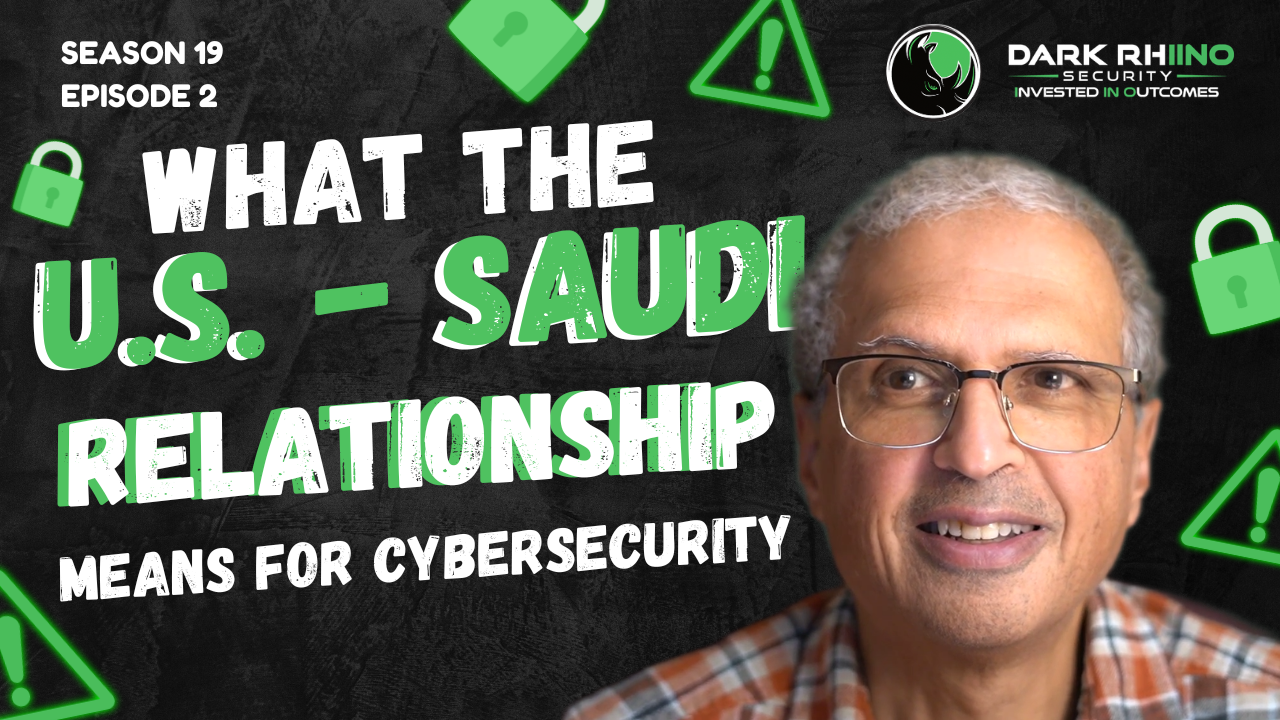
This week on Dark Rhiino Security’s Security Confidential podcast, Host Manoj Tandon welcomes Jason Roos. Jason is a globally recognized CIO, digital transformation leader with over 25 years of experience and the CEO of TAITAN. Jason has led major initiatives across the U.S., Europe, and the Middle East, including serving as CIO for NEOM’s Education, Research & Innovation sector. He’s also been named […]
Video
This week on Dark Rhiino Security’s Security Confidential podcast, Host Manoj Tandon welcomes Jason Roos. Jason is a globally recognized CIO, digital transformation leader with over 25 years of experience and the CEO of TAITAN. Jason has led major initiatives across the U.S., Europe, and the Middle East, including serving as CIO for NEOM’s Education, Research & Innovation sector. He’s also been named one of the Top 10 CIOs in the Middle East multiple times.
What the U.S.–Saudi Relationship Means for Cybersecurity | Security Confidential
Chapter Titles:
00:00 Intro
02:10 Our Guest
11:38 How do you balance convenience vs Security
17:30 De-provisioning gaps
22:36 Are people more accepting of compliance rules in the Middle East?
28:20 TAITAN
34:20 The current administration’s relationship with Saudi Arabia
43:29 Connecting with Jason
Audio:
Spotify Embed: S19 E02 What the U.S.–Saudi Relationship Means for Cybersecurity
Important Links
Transcript
Manoj Tandon:
Hello everyone, this is your host Manoj Tandon. Welcome to another episode of Dark Rhiino Security Confidential. I think you all know what I’m going to say next: We have a phenomenal guest. I’ll tell you who he is, but you’ve got to hit the like and subscribe button because we work for algorithms, and those algorithms matter. It’s the way we’re able to keep bringing you this great content. So please hit that like and subscribe button.
Without further delay, we have a phenomenal guest with us today. Jason Roos—he’s a globally recognized CIO, a digital transformation leader with over 25 years of experience. He’s the CEO of TAITAN. I hope I said that right—we’ll get into that. He’s led major initiatives across the US, Europe, and the Middle East, including serving as the CIO for Neom’s education and research innovation sector. He’s also been named one of the top 10 CIOs in the Middle East multiple times. Spends a lot of time over there. Welcome to the show, Jason. Glad you’re here.
Jason: Glad to be here. Thank you. I look forward to it.
Manoj Tandon:
ou know what—start us off with a little bit about your background. What’s your origin story? How’d you get here?
Jason Roos: I actually started my career in the US Army. I was a signals intelligence analyst specializing in electronic warfare and everything related to signals intelligence on active duty in the early 90s. That’s what really propelled me into a career in technology.
After active duty, I moved to Houston, Texas, and got into just about every aspect of IT—from writing code and software to managing networks and implementing operating systems like UNIX. This was during the early enterprise IT days when everything was thrown into IT, especially in small organizations. I worked in environments where IT teams were one to five people, so you had to do everything.
This was also the early days of cybersecurity, firewalls, and pre–Active Directory environments. I worked with AIX, SunOS, and various UNIX systems, then transitioned into Microsoft environments.
Manoj Tandon:
You must have spent some time on the VAX too then.
Jason Roos:
Not so much, but everything around that era. I came in when mainframe systems were still dominant and newer technologies were emerging. I got heavily involved in networking—MyCon, Nortel, Motorola, then Cisco as it took over the market, along with Ascend and 3Com. A lot of those companies are gone now, but it gave me a strong foundation in networking, TCP/IP, and securing data.
Eventually, I moved into healthcare IT at Texas Children’s Hospital, where I helped implement a Cisco network and Microsoft enterprise stack, including Active Directory. I stayed there about 10 years, completed a master’s degree, and rejoined the Army Reserve after 9/11 as a Medical Service Corps officer—essentially acting as a CIO for a combat support hospital. That role overlapped heavily with civilian healthcare—protecting electronic medical records and understanding exposure risks in military environments. After that, I moved to Abu Dhabi to help build Cleveland Clinic Abu Dhabi, where I was responsible for infrastructure technology.
Later, I joined Symantec in Mountain View, working on various roles, including overseeing the Norton e-commerce platform. Then I moved to Stanford as VP and CTO for their hospitals and clinics.
After that, I went back overseas to Saudi Arabia to work at KAUST—King Abdullah University of Science and Technology—which was designed to be like MIT or Caltech for the Middle East.
KAUST was a fully built city with advanced research infrastructure—supercomputers, nanofabrication labs, and global partnerships with companies like Aramco, Dow, Lockheed, and Boeing. It was also a unique environment socially, offering freedoms within a secure, walled campus long before broader reforms in Saudi Arabia.
Jason Roos:
As CIO and later Chief Digital Officer, I expanded IT into a smart city “living lab,” testing autonomous vehicles, drones, and smart infrastructure with companies like Cisco, SAP, and Meta, along with government partners.
Manoj Tandon:
That’s incredible. So who owned the intellectual property coming out of KAUST—the individual, the university, or the Saudi government?
Jason Roos:
KAUST is a private university funded by an endowment set up by King Abdullah. It operates independently but collaborates with government entities. IP ownership depends on the project—some are university-funded, others involve government backing. The goal was always to drive innovation and diversify the economy beyond oil.
Manoj Tandon:
From a US perspective, people think of Saudi Arabia as restrictive. What you’re describing sounds very different.
Jason Roos:
Saudi Arabia has undergone massive change in the last decade. The population is young—mostly under 35—and very engaged with technology. There’s strong interest in AI, innovation, and global participation. Leadership has been pushing modernization across society and industry.
Jason Roos:
There’s also openness to using technology in culturally relevant ways—for example, managing massive pilgrimage crowds in Mecca using AI and computer vision to ensure safety.
Manoj Tandon:
That scale is insane—if it works there, it works anywhere.
Jason Roos:
Exactly.
Manoj Tandon:
Going back to your Army background—what lessons carried forward into your CIO and cybersecurity roles?
Jason Roos:
It gave me a natural reluctance to trust technology. In signals intelligence, you’re playing offense—you see how systems are exploited. That perspective sticks with you.
Manoj Tandon:
So how do you balance convenience versus security? It seems like convenience always wins.
Jason Roos:
It depends on the industry. Defense and healthcare are highly controlled, while universities are very open. The key is balance—minimizing exposure while enabling productivity. One major principle is limiting access. Most breaches happen through compromised credentials. If users only have access to what they need, you can contain damage quickly.
I personally avoided unnecessary access as a CIO. I didn’t want to be a vulnerability. Backup strategies are also critical. In healthcare, you can’t lose hours of data—systems must be designed for rapid recovery, and that requires investment and clear communication with leadership.
Manoj Tandon:
Deprovisioning is still a huge issue—ghost accounts everywhere.
Jason Roos:
Identity and access management is foundational. It’s basic cyber hygiene, but many organizations still struggle with it.
Manoj Tandon:
You’ve worked globally—are other regions more accepting of governance and compliance than the US?
Jason Roos:
It varies. Silicon Valley tends to “move fast and break things.” In Saudi Arabia, there’s strong emphasis on regulatory compliance, especially with new entities like the National Cybersecurity Authority.
However, compliance can sometimes become checkbox-driven rather than truly security-focused. Real security goes beyond compliance.
Manoj Tandon:
Is this what led to TAITAN?
Jason Roos:
Yes. After working with Neom, I gained Saudi premium residency, which allowed me to operate independently. I became CEO of TAITAN Global. TAITAN focuses on connecting US and Saudi companies—helping US firms enter Saudi Arabia and Saudi firms expand into the US, especially in AI and advanced technologies. Saudi Arabia is investing heavily in AI, data centers, and infrastructure. They want companies to establish a presence—not just sell products but build operations locally.
Manoj Tandon:
Do they have the infrastructure for that scale?
Jason Roos:
Yes. They have strong energy resources and are investing in green energy as well. Power isn’t a constraint.
Manoj Tandon:
Does regional conflict affect this momentum?
Jason Roos:
In the short term, it creates uncertainty, but long term it may lead to greater stability. It could also create more opportunity, as Saudi Arabia increases incentives to attract investment.
Manoj Tandon:
Where do you see AI leading in the region?
Jason Roos:
Healthcare, genomics, green energy, water desalination, and airspace management. Saudi Arabia can move faster than the US in many areas due to less bureaucracy.
Manoj Tandon:
Final thoughts for our audience?
Jason Roos:
AI is transforming everything. IT will look completely different in a few years. The real power will be in business users leveraging AI—not just IT teams.
And Saudi Arabia is at the forefront of this transformation, with unprecedented partnership opportunities with the US.
Manoj Tandon:
If someone wants to reach you?
Jason Roos:
Go to taitanglobal.ai—T-A-I-T-A-N global dot AI. You’ll find my contact info there.
Manoj Tandon:
Jason, this was fantastic. Thanks for sharing your insights and clearing up a lot of misconceptions. You’re always welcome back.
Jason Roos:
Appreciate it. Thank you.
Manoj Tandon:
Take care.
Read more about Jason on his LinkedIn
Check out the other episodes in Season 19:
Ep. 0 Diyar Saadi – How Hackers Exploit Hidden Vulnerabilities
Ep. 1 Krisztian Kiraly – Who Really Controls Your Algorithm Data?
Ep. 2 Jason Roos – What the U.S.–Saudi Relationship Means for Cybersecurity
Ep. 3 Jasson Casey – Identity Attacks Are the #1 Threat
Ep. 4 Andy Smith – What Good Is Cybersecurity Tech… If It Still Fails?
Ep. 5 Murphy John – The Future of Decentralized Data
Ep. 6 David Linthicum – Artificial Intelligence Mistakes Every Company is Making Right Now
Ep. 7 Bronwen Aker – Treat Artificial Intelligence like a Drunk Intern
Ep. 8 Yagub Rahimov – You Can Get Hacked With Emojis
Ep. 9 David B. Cross – The Future of Cyber Threats
Ep. 10 Mark Kreitzman – The Hidden Cost of Mobile Identity Theft
About Jason Roos

Jason Roos is a seasoned CIO and digital transformation leader with over 25 years of global experience across the United States, Europe, and the Middle East.
He has led large-scale technology and innovation initiatives for some of the world’s most forward-looking organizations, including serving as Vice President of Digital Transformation and CIO for NEOM’s Education, Research & Innovation sector—part of Saudi Arabia’s Vision 2030.
Prior to NEOM, he spent nearly eight years as Chief Technology Executive at KAUST, where he was recognized by CIO Magazine as one of the Top 10 CIOs in the Middle East for three consecutive years.
Today, Jason advises AI companies and organizations navigating complex digital and innovation strategies.
About Us:
Dark Rhiino Security’s Security Confidential is a weekly Cybersecurity podcast where Host, Manoj Tandon, talks to Infosec and Cybersecurity professionals about the current issues going on in our industry. Guests are able to share their stories about how they began their journey into cybersecurity and connect with our audience. Listeners are able to tune in through Spotify, Apple Podcasts, Google Podcasts, Amazon Music, iHeartRadio, Youtube, LinkedIn, and more.
For inquiries, please email media@darkrhiinosecurity.com
Share and spread the word!
Original podcast listings
S19 E02 What the U.S.–Saudi Relationship Means for Cybersecurity
Archive source: Original website record. Original wording and artwork retained.