SECURITY CONFIDENTIAL
Security Confidential S10 E9 Chris Cazel
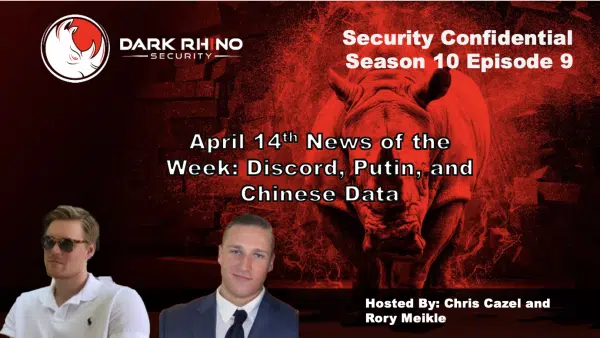
This week on Dark Rhiino Security’s Security Confidential podcast, Host Rory Meikle talks to Chris Cazel about War Thunder, Russias new bill, Apples Terms and Conditions, and more that you should know about Chapter Titles: 00:00 Introduction 02:53 War Thunder Discord Documents 11:54 U.S. taking your Data vs. Chinese taking your Data 13:49 Apple Has Weird Terms […]
Video
This week on Dark Rhiino Security’s Security Confidential podcast, Host Rory Meikle talks to Chris Cazel about War Thunder, Russias new bill, Apples Terms and Conditions, and more that you should know about
Discord, Putin, and Chinese Data | Security Confidential
Chapter Titles:
00:00 Introduction
02:53 War Thunder Discord Documents
11:54 U.S. taking your Data vs. Chinese taking your Data
13:49 Apple Has Weird Terms and Conditions
15:23 A Guide to Understanding the Hoax of the Century
22:00 Russia’s Electronic Draft Bill
Audio:
Spotify Embed: S10 E9 Discord, Putin, and Chinese Data
Important Links:
Transcript
Rory Meikle: Welcome to an episode of Security Confidential. I am co-host Rory Meikle with co-host
Chris Cazel: Chris Cazel. There you go.
Rory Meikle: Filling in for Manoj Tandon. I feel like that’s due since he’s the main host. So, a little different podcast for you today. Obviously, number one, we are in the studio here at the HQ in Dublin, Ohio. Back at it again. You might recognize us from our last video, Defense in Depth walkthrough.
Chris Cazel: Yes, sir.
Rory Meikle: And I was honestly just thinking I was wearing the exact same shirt in that video as I am right now. If we double-checked, I’m not. So it is confirmed: I do own more than one collared shirt, which is cool. Always good to know.
Chris Cazel: Yeah, right? Fresh.
Rory Meikle: So in today’s episode of Security Confidential, instead of having some really awesome guest on here who has a ton of life experience and industry knowledge of whatever it is that they do, Chris and I are just going to kind of talk about some news events in the cyber world or in other news events that we see. And just kind of, maybe we can make you laugh. We’ll probably be laughing a lot because it’s going to be ridiculous. But yeah, that’s kind of the gist of this, just to be a little easier, lighthearted. I guess you could call this your non-mainstream news outlet.
Chris Cazel: There you go.
Rory Meikle: Reporting not live, because this is—you’re going to watch this some predestined time from now. Maybe someday. Maybe live. Maybe someday it’ll be live. But yeah. So, what’s the week? What is this week? April something.
Chris Cazel: It is the 14th.
Rory Meikle: 14th? Okay. So this is Friday, April 14th, right now. So we’re doing things from this week and previous weeks that we’ve kind of just seen in the news and have thought they’ve been pretty funny. So, what do you got for us, Chris?
Chris Cazel: Well, we’ve got a bunch of things. We share all these articles every week about security-related stuff. Kinda. Some are a bit of a stretch, but there’s an old story from a couple weeks ago that sort of ties into a ridiculous one from this week that’s in the news. So, I’ll set the stage and you follow it up with how it ties in.
Rory Meikle: All right, I can do that.
Chris Cazel: Okay, sweet. So, if you’re not familiar, there’s this game. It’s a PC game called War Thunder. Maybe we can show something on screen here, but it’s like a vehicular combat sort of game. And it’s played online, so a bunch of people—a bunch of people playing, a bunch of, like, boomers playing, essentially. And it’s vehicular combat, so you’re piloting some kind of tank or some kind of airplane, some kind of vehicle, right? Some kind of war-related vehicle.
And basically a couple weeks ago—I don’t know if you would have seen this in the news or not—but there’s people from like China and Scandinavia, people from Eastern Europe, the Slavic regions. They’re all talking about like, “This vehicle doesn’t do enough damage, and I know because I worked on one when I was in the armed forces.” Absolutely insane.
So they’re like, all these old guys are—I assume they’re older gentlemen, just from the way that I’ve seen them write on the forums, but they might not all be older folks. It might just be [foreign] but they’re basically arguing that “my tank from Ukraine” or something like this doesn’t do enough damage. And they’re taking all these classified government documents, like confidential schematics of tanks and planes, yada yada. They’re taking them, posting them on the thing and being like, “The shell comes out of the…” I don’t even know what the term is for the turret, the main gun—the specs for the main gun that say so many meters per second.
And basically, they’re arguing on the forums about buffs for their vehicles so that they can win this game that’s more realistic. And they’re all sharing classified documents. So everybody’s getting in trouble for sharing these things, and forums are banning you for sharing government secrets online, that kind of thing.
So then, that’s what happened in the last few weeks, maybe a month or so ago. This was in the news a lot, maybe a month or two.
Rory Meikle: Yeah, I think it was like February when it really broke, but they’ve been doing that since June is what I had read, discovered, whatever. And the posts aren’t there anymore, so if you’re trying to see classified information, you can’t anymore. But it was out there at one point.
Chris Cazel: Yeah, but the lid really got blown off the top, I think. There’s a good video on YouTube if you want to watch it. It’s by this dude, his channel is called Angry Cops. It’s probably one of the more recent posts. But anyways, he talks about it. They were posting like the specifications to the F-16 fighter jet. That’s obviously supposed to be classified, and all its different systems and stuff, like its GPS, how it knows where it is in the sky, how it targets enemies and stuff.
So like, clearly information that you wouldn’t want your enemies to know, because they can just figure out then how to counteract that system. But they’re posting stuff like that to prove their point that this jet doesn’t fire accordingly. It’s actually made so that they can win at War Thunder.
But then how does that bring us into today?
Rory Meikle: Well, now, today—so this week—if you’ve been paying attention to the news at all, I’m sure you will have seen all the hype around these leaked documents from the CIA, different government agencies, pertaining to like the war in Ukraine, how we’re spying on our allies, just a whole bunch of different stuff.
And the whole gist of it is that these documents were posted on an online server and in Discord, very similar to what was going on with these other classified documents in War Thunder. So this has been a problem going on for months now—eight or nine months—to where clearly there’s some drop in government ability to control the data, control their data, control who has access to their documents, and what’s going on with it, and who’s posting it where and for what reasons.
And the most recent leaker, just today or last night, whatever, they caught them. Not that that really matters; what really does matter, though, is the information that was in all these documents. I would highly suggest everyone to check out the YouTube channel Breaking Points and any of their coverage on this week from these classified documents. It has been fantastic, kind of breaking down what was in a lot of them, because that is the main point of the story, not really who leaked it.
Chris Cazel: I haven’t seen any of the content; I’ve only seen that they arrested the guy on Good Morning America.
Rory Meikle: Yeah, see, that’s what I mean. The mainstream has been pushing the narrative that the problem is finding the guy who leaked these articles, not what’s actually in them. Breaking Points has been covering the content. They’ve gotten about 50 of these documents sent to them, and they’ve gone through them and are reporting on what they actually say.
But the gist was that it wasn’t some public service—it was like War Thunder. He was just trying to argue a point with his friends. It wasn’t like an Edward Snowden whistleblowing thing. It was literally just like, “Yo Chris, check out this document.”
Chris Cazel: Because on the news, they portray it like it’s some defector leaking everything.
Rory Meikle: Yeah, that is not the truth at all.
Chris Cazel: Interesting. I’ll have to read the content. Are they still out there?
Rory Meikle: They’re trying to scrub them, obviously. But journalists likely have copies offline. What I heard was there were over 679 documents originally posted, and they’ve only recovered about 50.
Chris Cazel: So they’re still out there somewhere. Interesting. Crazy stuff.
I wonder how that even happens. Like, I mean, people are remote, but don’t you have government devices? How does that get out there?
Rory Meikle: Yeah, from my experience, you couldn’t even plug your phone in to charge it.
Chris Cazel: So how does it get out there? Are they emailing it?
Rory Meikle: From what I’ve heard, he printed the documents, took them home, photographed them, then returned them.
Chris Cazel: That’s a red flag right there. Nobody uses printers anymore.
Rory Meikle: Right.
Chris Cazel: What else you got?
Rory Meikle: There are two giant governments collecting your information, right? Whether you’re doing something illegal or not, the U.S. government can act on your data.
If my info goes to China, what do they actually do with it that impacts me?
Chris Cazel: So you’re saying one can act on it and one can’t?
Rory Meikle: Exactly. If I had to choose, why give it to the one that can directly impact my life?
Chris Cazel: I see what you’re saying.
Rory Meikle: It’s foolish to think the U.S. government doesn’t use your data. The difference is China is upfront about it. The U.S. uses companies and terms and conditions you don’t read.
Like Apple’s terms—crazy stuff buried in there.
Chris Cazel: Like you can’t use iTunes to build nuclear weapons.
Rory Meikle: Exactly. Nobody reads that.
I also read this article today—“A Guide to Understanding the Hoax of the Century.” It talks about censorship under the guise of disinformation. It’s long but well-sourced.
We should link it.
Chris Cazel: Yeah, we can do that.
Rory Meikle: If you’re not questioning what you’re told, you’re probably accepting things you shouldn’t.
Chris Cazel: Disclaimer—we don’t want any government to have our data.
Rory Meikle: Right, but if I had to choose…
Chris Cazel: I get it.
That ties into something I read—Russia is pushing a bill to draft soldiers electronically. You’d get notified digitally, and if you don’t respond in 20 days, they revoke your rights.
Rory Meikle: That’s wild.
Chris Cazel: Yeah, it ties back to data control.
Rory Meikle: You’re saying the U.S. could do that?
Chris Cazel: It would be very easy.
Rory Meikle: That’s scary.
Chris Cazel: Imagine missing a draft email in spam.
Rory Meikle: Yeah, that’s insane.
Chris Cazel: That’s why your point matters—China can’t draft you.
Rory Meikle: Exactly.
Chris Cazel: Switching gears—don’t plug your phone into random USB ports.
Rory Meikle: Right. Use a proper outlet.
Chris Cazel: When I plug my iPhone into my computer, it asks for permission—but does the phone ask the same?
Rory Meikle: It should.
Chris Cazel: It’s weird that it doesn’t.
Rory Meikle: We should test it.
Chris Cazel: Yeah, and also test what data Riot Games sends.
Rory Meikle: Add it to the list.
Chris Cazel: If plugging into a public port gives access, that’s dangerous.
Rory Meikle: Especially if it bypasses phone security.
Chris Cazel: Exactly.
Rory Meikle: Alright, we’ll test it and report back.
Chris Cazel: Anything else?
Rory Meikle: I think that’s it.
Chris Cazel: Yeah, I’m good.
Rory Meikle: Alright. Thank you for tuning in to this episode of Security Confidential. If you liked this, let us know in the comments.
Chris Cazel: If you hated it, also let us know.
Rory Meikle: Either way, write something.
Chris Cazel: Thanks, see ya.
Rory Meikle: Bye-bye.
Check out the other episodes in Season 10:
Ep. 0 Dark Rhino Security – Oktane Conference
Ep. 1 Jax Scott – Helping Pave the Way for Women in Cyber
Ep. 2 David Meece – The Secrets of LinkedIn’s Algorithm
Ep. 3 Mike Rice – How Smartwatches Lead Iran to U.S. Troops
Ep. 4 Mike Rice – Why is the U.S. Banning Tiktok?
Ep. 5 Shea Nangle – Hack-Back: What does it mean?
Ep. 6 Josh Mason – U.S. Air Force Academy to Teaching Cyber
Ep. 7 Joel Beasley – Stop Playing the Victim Role
Ep. 8 Melissa Thornley – How Do You Build A Leader
Ep. 9 Rory Meikle and Chris Cazel – April 14th Tech News
Ep. 10 Tom Dusenberry- Building Successful Video Games
About Us:
Dark Rhiino Security’s Security Confidential is a weekly Cybersecurity podcast where Host, Manoj Tandon, talks to Infosec and Cybersecurity professionals about the current issues going on in our industry. Guests are able to share their stories about how they began their journey into cybersecurity and connect with our audience. Listeners are able to tune in through Spotify, Apple Podcasts, Google Podcasts, Amazon Music, iHeartRadio, Youtube, LinkedIn, and more.
For inquiries, please email media@darkrhiinosecurity.com
Share and spread the word!
Original podcast listings
Archive source: Original website record. Original wording and artwork retained.